(Angelo Paratico) In the heart of Stelvio National Park, among snow-capped peaks, a trail of dinosaurs from the Late Triassic period has emerged, preserved in the dolomitic rocks of the Italian Alps.
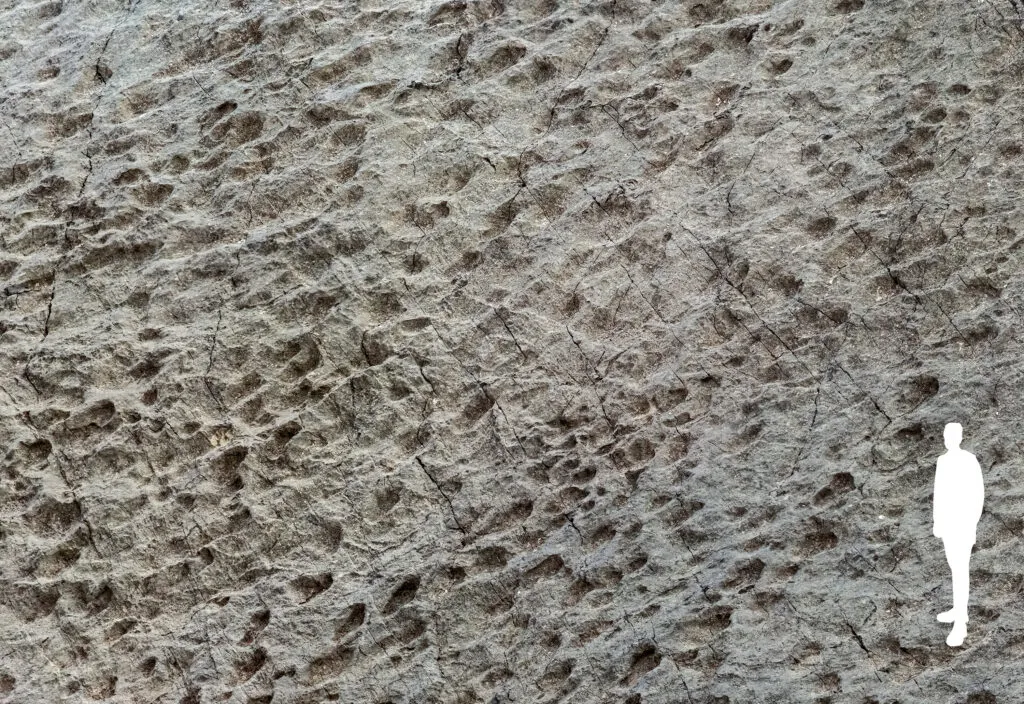
Where are visible
This extraordinary discovery was made a few months ago and is welcome news in the run-up to the Cortina Olympics. The site is in the Fraele Valley, in the province of Sondrio, within Stelvio National Park, in an alpine landscape that will soon host the 2026 Winter Olympics and Paralympics in Milan-Cortina. The Fraele Valley, a place of paradisiacal beauty, lies in the Alta Valtellina.

Accessible via a winding road marked on the provincial route from Bormio to Livigno, the entrance is signposted by two towers called the Fraele towers, visible from the road ascending from Bormio. There are no inhabited centres in the valley, only a few accommodation facilities open during the summer season.
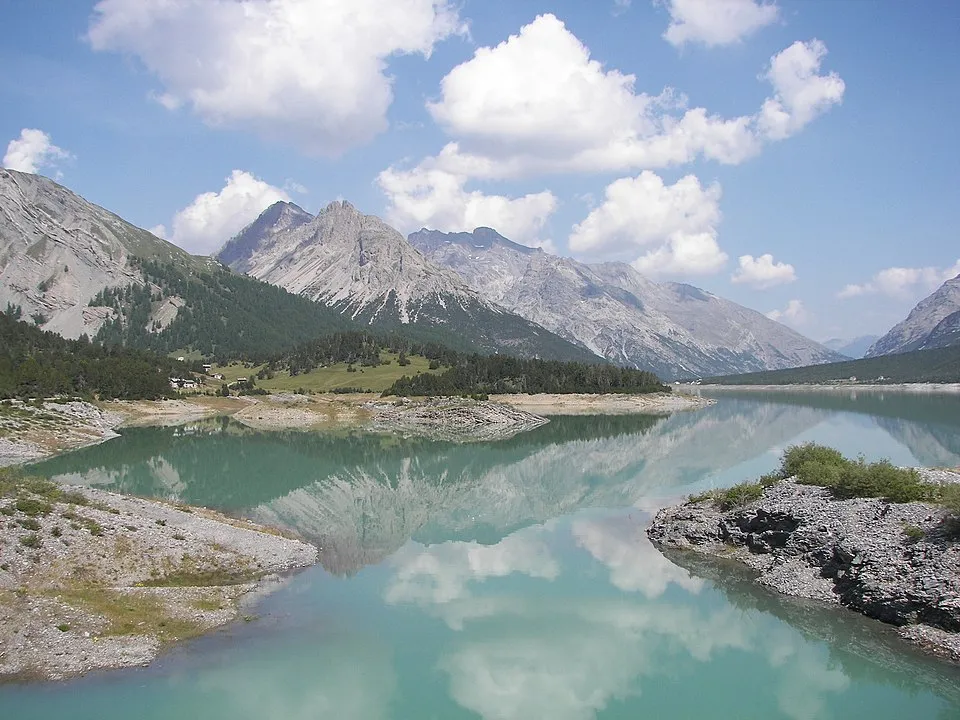
To the southeast, the valley opens towards the town of Bormio, and to the south towards Isolaccia (to which it is connected by the road). To the northwest, it borders the Gallo and Mora valleys (named after the rivers that form them), not far from the border between Italy and Switzerland at the Mora Pass. Access to the unguarded border is via a dirt track unsuitable for vehicles.
The valley is characterized by two artificial lakes, the Cancano lakes, fed mainly by the waters of the Adda, whose source is in the extreme northwest of the valley and which flows out in the southeast. A third lake, Lago delle Scale, is at the southern entrance.
Who discovered the footprints?
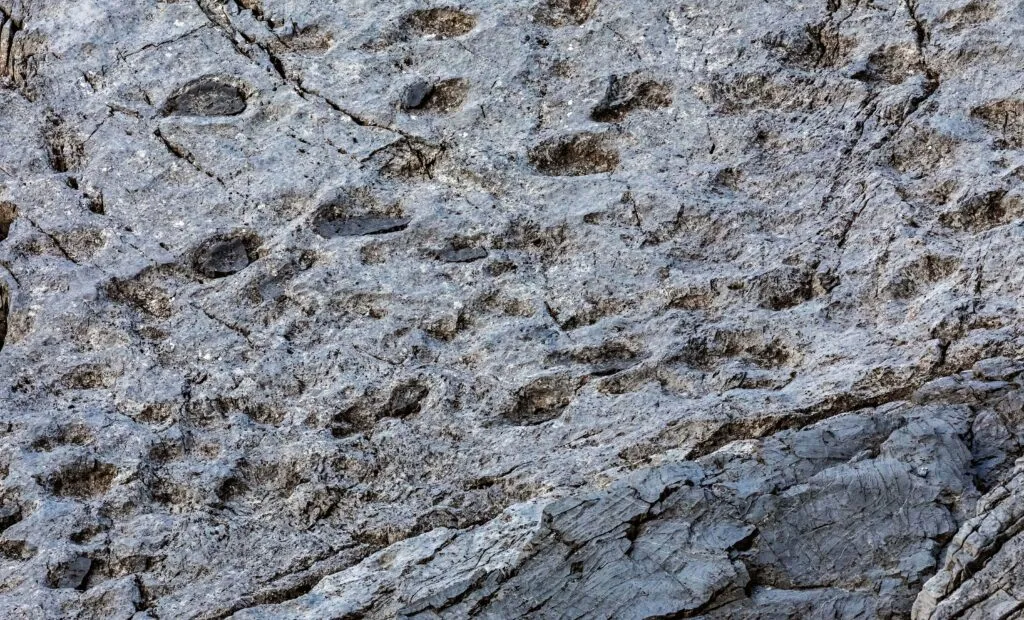
This extraordinary discovery, unparalleled elsewhere in the world, was made by chance by photographer Elio Della Ferrara. On 14 September 2025, he discovered thousands of perfectly preserved dinosaur footprints from the Late Triassic period on a vertical wall (which was horizontal 200 million years ago). With the rest of the day at his disposal, Elio decided to take a closer look at the mystery that was troubling him. He laboriously climbed a steep slope and, reaching the base of one of the outcrops, realized that he was looking at hundreds of fossilized footprints. While photographing Alpine fauna, Della Ferrara observed a series of depressions aligned on an almost vertical rock face through his binoculars. What he discovered was completely unexpected: these depressions turned out to be a succession of fossilized dinosaur footprints, some up to forty centimeters in diameter, with perfectly outlined toes and claws. Some showed clear traces of toes and claws: these were undoubtedly the footprints left by large animals of the past. The next day, having hardly slept, Elio called Cristiano Dal Sasso, a palaeontologist at the Natural History Museum in Milan, whom he already knew from a previous collaboration, to confirm this fascinating hypothesis. When Dal Sasso saw the first photos on his mobile phone, he could hardly believe his eyes: they were certainly dinosaur footprints, never reported before.
The next day Cristiano Dal Sasso of the Natural History Museum of Milan, who, after receiving and examining the first images confirmed that the footprints were indeed dinosaur footprints, giving the discovery scientific validation.
According to initial geological analyses, the footprints are imprinted in the so-called main dolomite, a sedimentary rock formation dating back to the Norian period (227–205 million years ago). At that time, the Alps did not exist in their current form: the area was a tropical coastal platform, washed by the Tethys Ocean, with wide muddy plains ideal for preserving animal footprints.
Over the millennia, those soft sediments hardened and, following the collision between the Eurasian and African plates that gave rise to the Alps, they were lifted and rotated, transforming from flat surfaces into almost vertical rock faces, now at an altitude of over 2,400 metres. And there, still intact, the footprints remained.

Who left these footprints?
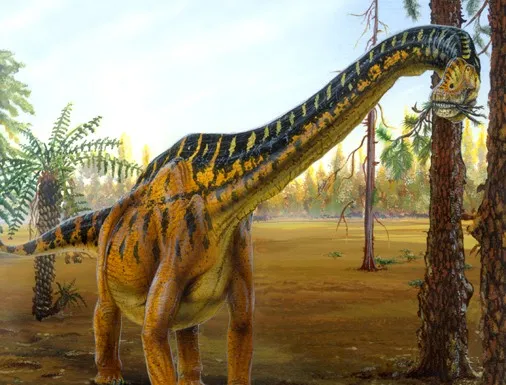
Most of the tracks belong to prosauropods, large herbivorous dinosaurs that were the precursors of the giant sauropods of the Jurassic period, such as Brontosaurus. These were bipedal animals with long necks and small heads. According to experts, one of the most likely candidates for the maker of these footprints is Plateosaurus engelhardti, whose skeletons have been found in Switzerland and Germany and which could reach ten metres in length.
In addition, some footprints show traces of the front limbs, indicating that the animals stopped at certain times and placed their front legs on the ground. Signs of parallel and synchronised movements have also been identified, suggesting social behaviour in herds, which is unusual for this period.
A deposit of colossal proportions
At least thirty outcrops have been identified, with densities of up to six footprints per square metre. Preliminary estimates suggest several thousand individual footprints. Due to the inaccessibility of the terrain, the study of the deposit will be conducted using remote sensing technologies, drones, and photogrammetry. These tools will allow each footprint to be documented without damaging the site and ensure its long-term preservation, according to officials at the Museum of History.