It is said that Salvatore Quasimodo (1901–1968) wrote only one poem that everyone knows, the one inspired by Psalm 137 of the Bible. However, it would be more accurate to call it plagiarism than inspiration. In 1959, he won the Nobel Prize for Literature, but, as Giuseppe Prezzolini wrote in his Pocket History of Italian Literature, “no one knows exactly why.” Quasimodo was better known as a translator than as a poet.

Here is Salvatore Quasimodo’s poem from the collection Giorno dopo Giorno:
And how could we sing
with a foreign foot on our hearts,
among the dead abandoned in the squares
on the hard grass of ice, to the lament
of the children like lambs, to the black scream
of the mother who went to meet her son
crucified on the telegraph pole?
To the branches of the willows, by vow,
our harps were also hung,
swaying gently in the sad wind.
Here is part of Psalm 137, taken from the Bible and known as The Song of the Exile. The last words are never read in church, as they are very violent: “Blessed is he who seizes your little ones and smashes them against a rock,” which must have inspired Quasimodo’s image of the son crucified on the telegraph pole.
Here is The Song of the Exile from the Bible:
By the rivers of Babylon,
there we sat down and wept
when we remembered Zion.
On the willows of that land
we hung our harps,
because there our captors asked us for songs,
our oppressors for joyful songs.
Quasimodo’s poem is used as a reminder of the Resistance, in which Quasimodo never participated. In 1940, after the war had begun, he wrote for the magazine Primato thanks to Minister Giuseppe Bottai. In the following years, he was reproached for supporting the use of the formal “voi” in an article in a 1939 monographic issue of the magazine Antieuropa and for sending a plea to Mussolini, asking to be awarded a grant so he could continue his writing. During the war years, he devoted himself to translating the Gospel according to John, Catullus’s poems, and the Odyssey. In 1945, he joined the Italian Communist Party, as did many former fascists of the “giant kangaroo” variety, where he remained for a couple of years, waiting for the storm to pass.
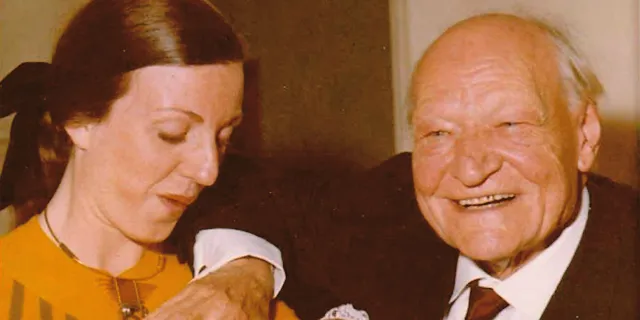
According to the testimony of Giuseppe Ungaretti’s (1888–1970) last great love, the Italian-Brazilian Bruna Bianco, now 86, Quasimodo ensured that the Nobel Prize was never awarded to his enemy Ungaretti by showing the Swedish academics a book by Ungaretti dedicated to Mussolini. The story between Ungaretti and Bianco is somewhat reminiscent of that between Ernest Hemingway and the Venetian Adriana Ivancich.
Ungaretti and Bianco met at the Ca’ d’Oro, a hotel in São Paulo owned by Veronese. Bruna Bianco was 26, born in Cossano Belbo, and Ungaretti was 78. She had been living in Brazil for ten years and worked for her father’s winery. She wrote poetry and now divides her time between Pietra Ligure and Brazil. She knew nothing about Giuseppe Ungaretti but loved to hear Italian spoken. She had read in the newspaper that he was a poet and decided to meet him. She entered his hotel, and it was love at first sight. She recalls: “I was waiting for him in the lobby. When he walked in, I did not understand what was happening to me. We talked for an hour, he invited me to breakfast, he asked for my phone number.” She gave him the phone number of the winery. “Then he hugged me and accompanied me with a long gesture of his hands. My whole body was filled with a long, intimate vibration, a sensory pleasure I had never experienced before.”
It was like meeting Homer himself, who had come out of Hades, and she was fascinated: “I had met such a complete man that I thought I could introduce him to my father immediately and announce that I intended to marry him. I was upset. No one had ever made me vibrate so madly at their touch.” Three years of passion followed, with rare encounters: six in all, three in Brazil and three in Italy. It was not a platonic love but also a carnal one. Bruna remembers that he had beautiful hands and that his skin smelled like that of a freshly washed baby.

They wrote the poems in Dialogo together and dreamed together, and in the end they thought about marriage. They needed a place to live, but Ungaretti lived with his daughter and son-in-law, occupying a small room in their flat in the EUR district. He was certainly not rich, despite the fame and popularity he had gained with his extraordinary television readings of the Odyssey. He still hoped for the Nobel Prize (he talked about it at length with Bruna) so that he could have the money to buy a small house in Capri, but the prize never came, thanks to Quasimodo.
Bruna says, “We promised each other that if our love waned, we would no longer write to each other.” Their relationship ended, and she became a famous Brazilian lawyer and started her own family. Ungaretti had written to her that he was a soldier and only wanted his Bruna to be happy; nothing else mattered.
The correspondence between Ungaretti and the French critic and translator Jean Lescure resurfaced a few years ago, revealing Ungaretti’s contempt for Quasimodo, whom he described as “a parrot and a clown.” He emphasized that Quasimodo’s anti-totalitarian credentials had been largely retroactively assigned: “He collaborated for twenty years with the most strictly orthodox fascist magazines… and his poems on the Resistance were written after the end of the Resistance, long afterwards, because it was fashionable.”
His words for the institution created by the inventor of dynamite are scathing: “You know that the Nobel Prize is awarded by four ridiculous poets. The others are men of science, and the most idiotic of the four is the permanent secretary. Do you understand the seriousness of the Nobel Prize? The shit that the Nobel Prize really is?”
Harsh words, but not without some truth. The Swedish academics’ reluctance to consider awarding Jorge Luis Borges had been well known for some time, because in his youth he had not been openly hostile to fascist dictatorships. Some time ago, a scholarly work by Professor Tiozzo, Italy’s leading observer of Nobel Prize matters, based on the Academy’s minutes, demonstrated how Ezra Pound, who had come close to winning the prize, was stopped because of his open sympathy for Mussolini’s ideology. Ungaretti was denied the Nobel Prize because Quasimodo had pointed out to the Stockholm academics the presence of one of Ungaretti’s books with a dedication to Mussolini.
One might recall the fable of the fox who cannot reach the grapes, but Ungaretti needed the large sum of money that came with the prize, not fame, which would have allowed him to take his beautiful Bruna to Capri and then live on that island, like Ulysses returning from Troy.