(Angelo Paratico) The concept of ‘asymptomatic carriers’ of a disease is not new. It was first formulated by Ludovico Settala, the Milanese doctor who appears in *The Betrothed*. It can be found in his 1622 book *De Peste et Pestiferis affectibus*, in which he states, with great foresight, that the plague is a contagion transmissible from person to person (the ‘passage of corruption’). All in all, this was a rather conspiracy-theory-like view for the time, given that the vast majority of people believed it was caused by some external factor, such as Don Ferrante, who blamed astral influences, or the clergy, who saw it as divine punishment. According to Settala, who had observed the previous plague of 1576, all it took was “a touch, and it is carried by infected people or goods”.
Settala drew on the work of a brilliant Sicilian physician, Giovanni Filippo Ingrassia (Regalbuto, 1509 – Palermo, 1580), who had stated that ‘an infected handkerchief is enough to destroy an entire nation’. That Settala was an attentive reader of his work is also evident from the fact that, having learnt of the arrival of a Germanic army, he foresaw a new plague and, as a countermeasure, suggested the construction of a gallows in the market square to intimidate citizens and travellers, on which all those who refused to follow the health regulations were to be hanged.
When Alessandro Manzoni wrote *The Betrothed*, even in its first version of 1827, the concept of the transmissibility of an infectious disease was not yet accepted by official science; yet the author of that masterpiece chose the right path, thanks above all to his personal physician, Enrico Acerbi (Castano Primo, 1785 – Tremezzo, 1827), who had the honour of being cited in a footnote in his masterpiece. Scholars of *I Promessi Sposi* know that he featured only three of his contemporaries in the book: Tommaso Grossi, Giovanni Torti and, indeed, his doctor and friend, whose book *Del Morbo Petecchiale… e degli altri contagi in generale* (On Petechial Fever… and Other Infectious Diseases in General), published in Milan in 1822, he mentions. In that book, Acerbi clearly explains why epidemics break out, and it follows that the way to overcome them remained the same as that already employed by Settala and Tadino – who had in turn adopted it from Ingrassia – and which can be summarised by the 3 Fs: Iron, Fire, Gallows.
Copyrighted work available under Creative Commons Attribution only licence CC BY 4.0 http://creativecommons.org/licenses/by/4.0/
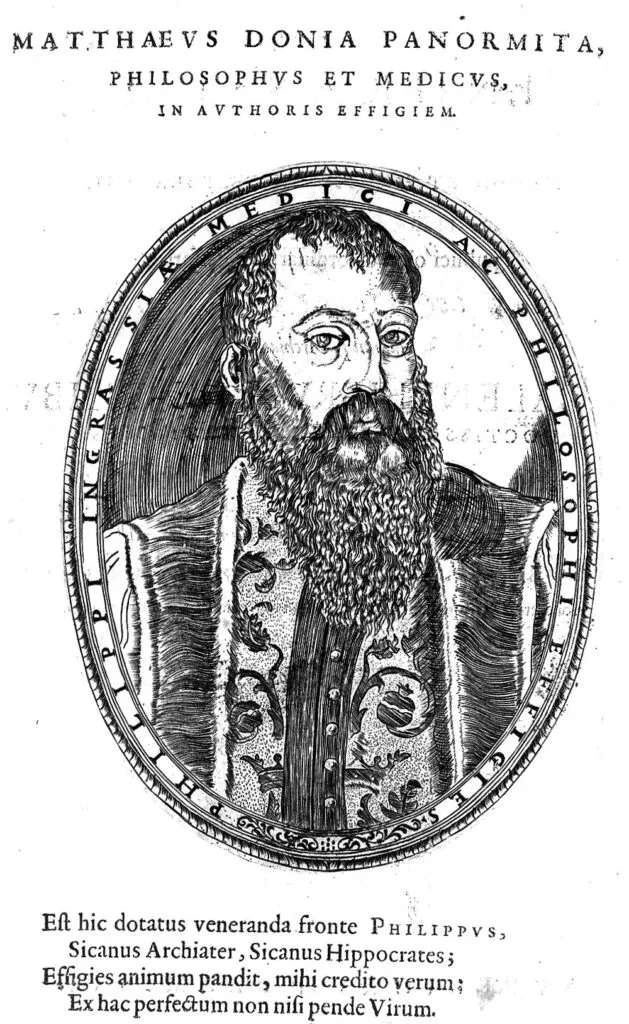
Let us recall Giovanni Filippo Ingrassia, a little-known figure despite the many books he published, who deserves to be counted amongst the world’s greatest physicians.
In 1544, Ingrassia became the personal physician to Isabella Di Capua and took up a teaching post in Naples, which he left only when the Viceroy of Sicily, Juan de Vega, established a school of medicine in Palermo. In 1553, the viceroy outlined in a letter to the senators of Palermo the benefits the city would gain by appointing Ingrassia as a professor of medicine, and in January 1554, he was appointed to the post.
In 1575, Ingrassia found himself having to deal with the Sicilian phase of a terrible plague epidemic, which struck the city of Palermo with great ferocity, ravaging it for over a year. By decision of the viceroy, Ingrassia was granted almost dictatorial powers. In this capacity, he implemented a policy of strict isolation to prevent the spread of the disease. He instructed the council he headed to set up quarantine stations throughout the city; he ordered that the sick be kept separate from those recovering, and that the latter be released from isolation only two months after the fever had subsided; he imposed quarantine on ships arriving in the harbour; he hindered trade; he prohibited, or discouraged, all gatherings, even those for religious ceremonies; he advocated extremely harsh punishment: hanging and quartering for those who stole and resold the clothes of plague victims, which were destined to be incinerated. His plan of action succeeded in limiting the effects of the disease to a surprising degree: there were around 3,000 victims (in Venice, in the same year, 60,000 deaths were recorded).
Giovanni Filippo Ingrassia recorded the experience he gained during the epidemic in his *Informatione del pestifero, et contagioso morbo, il quale affligge et have afflitto la città di Palermo et molte altre città e terre di questo Regno di Sicilia negli anni 1575 e 1576*. This work was made known throughout Europe by J. Camerarius, who translated it into Latin (Synopsis… commentariorum de peste… auctoribus Hieronymo Donzellino, Iohanne Philippo Ingrassia, Caesare Rincio, Ioachimo Camerario, Nuremberg, C. Gerlach – Err. I. Montanus, 1583). It is evident from this that the theoretical conviction underpinning all his interventions was based on the correct intuition that contagion occurred via an unknown fomite and through contact. Hence, his focus on isolating the sick and destroying the fomite, thereby effectively halting its transmission.