By Francesca Romana Riello
Osvaldo Bagnoli died this morning at the age of 91. As manager, he guided Hellas Verona to the 1985 Serie A title, the only Scudetto in the club’s history.
Bagnoli led Verona to the 1984-85 Serie A title – the only league championship the club has ever won – securing his place not only in the club’s history but in the collective memory of the city itself.
He arrived at Verona in 1981, when the club were still competing in Serie B. Before embarking on a successful managerial career, Bagnoli had been a midfielder, developing through AC Milan’s youth system before playing for several clubs, including Verona, Udinese and Catanzaro. He first wore the yellow and blue shirt during the 1957-58 season, decades before returning to reshape the club from the dugout.
Under his leadership, Verona won promotion to Serie A, finished fourth in the top flight and reached two Coppa Italia finals. Yet it was the extraordinary 1984-85 campaign that would forever define his legacy.
The team that stunned Italy
That Verona side featured goalkeeper Claudio Garella, captain Roberto Tricella, Pietro Fanna, Antonio Di Gennaro, Domenico Volpati and Giuseppe Galderisi. During the summer of 1984, the arrivals of Hans-Peter Briegel and Preben Elkjær added both quality and character to an already well-drilled squad.
The season began with a statement victory, a 3-1 win over Diego Maradona’s Napoli. Verona climbed to the top of the table on the opening weekend and never surrendered first place.
It was a title built on consistency rather than fortune. Bagnoli’s side lost only two league matches all season, combining one of Serie A’s strongest defences with a tactical balance that reflected their manager’s calm, methodical approach.
On 12 May 1985, a draw away to Atalanta mathematically secured the Scudetto. As the final whistle sounded in Bergamo, thousands of supporters poured onto the streets of Verona to celebrate an achievement few had considered possible at the start of the campaign.
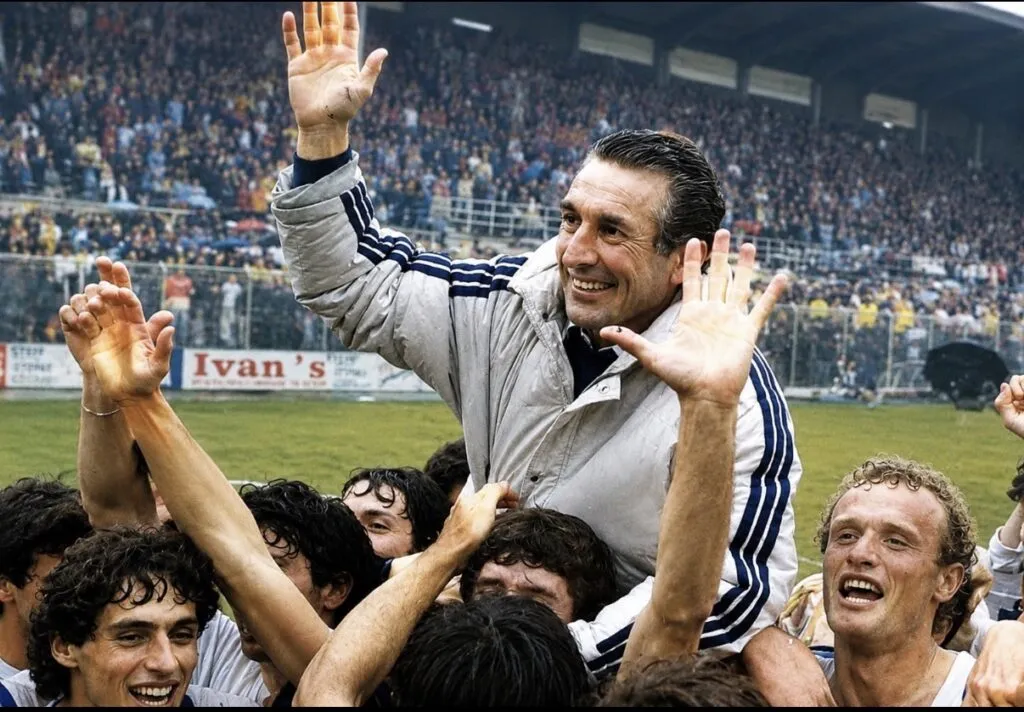
The quiet mastermind
Bagnoli remained in charge until 1990, leading Verona into the European CUP before his tenure ended with relegation during one of the club’s most difficult periods. That setback, however, did little to diminish the bond he had forged with the city over nine remarkable seasons.
He later managed Genoa, taking the club to the semi-finals of the UEFA Cup, before concluding his coaching career at Inter Milan.
Nicknamed Il Mago della Bovisa – “The Wizard of Bovisa”, after the Milan district where he grew up – Bagnoli earned a reputation for building teams that consistently outperformed expectations. Yet there was little mysticism behind his success. His strengths lay in meticulous preparation, a deep understanding of his players and an ability to read people as well as footballers.
Reserved by nature, he rarely sought the spotlight. Even after the Scudetto triumph, he spoke about that extraordinary season with characteristic humility, never allowing it to become a monument to his own achievements.
A legacy that endures
Verona’s Scudetto remains one of the most remarkable accomplishments in Italian football. It came at a time when Serie A was widely regarded as the strongest league in the world, featuring some of the game’s greatest players and clubs with vastly superior financial resources and richer traditions.
The memories of that season still resonate throughout the city: the flags hanging from balconies, the jubilant celebrations after the return from Bergamo, and the iconic image of Elkjær scoring against Juventus after losing one of his boots – a moment that has become inseparable from the mythology of that unforgettable side.
Even after retiring from football, Bagnoli maintained a close relationship with both Verona and Hellas without dwelling on past glories. In 2017, he was inducted into the Italian Football Hall of Fame, recognition that arrived many years after his final match as a manager.
Today, Verona has lost one of the defining figures in its sporting history. The Scudetto adorned the club’s shirts for only a single season, but its significance has endured for more than four decades. Behind that extraordinary achievement stands the same man who made it possible: Osvaldo Bagnoli, the manager who took Hellas Verona where it had never been before.