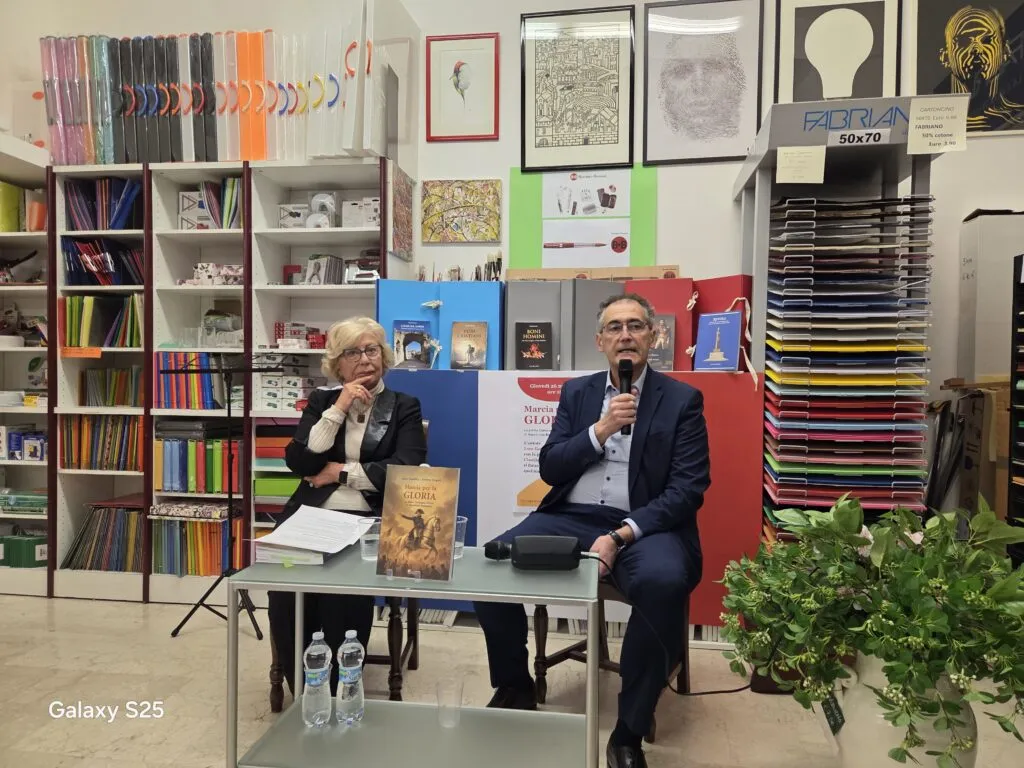
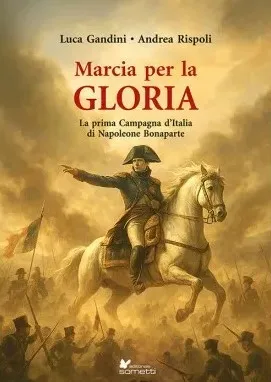
(Angelo Paratico) A few days ago, at the Mameli bookshop in Verona, we attended a presentation of the book “Marcia per la Gloria. La prima campagna d’Italia di Napoleone Bonaparte” (March for Glory: Napoleon Bonaparte’s First Italian Campaign), published by Sometti and co-authored by two highly knowledgeable historians: Luca Gandini and Carabinieri Corps General Andrea Rispoli.
Only the first co-author, Luca Gandini, was present at the event, and his talk was skilfully moderated by the Veronese historian Claudia Farina, who replaced Alessandro Barbero, who had performed the same role in Milan for a similar presentation a couple of months earlier.
This beautifully produced 327-page colour book features a remarkable collection of photographs and maps.
It opens with a brief biography of Napoleon Bonaparte and the events that led to his appointment as commander of the Armée d’Italie. His victories, considering the pitiful state of his soldiers, were lightning-fast, beginning with the conquest of Piedmont, which started with the Battle of Montenotte on 12 April 1796, and ending with the capitulation of Mantua on 2 February 1797. It then continues with the entry into Veneto, crowned by the splendid victory at Rivoli, near Verona, on 14 and 15 January 1797. Before Rivoli, Napoleon was seen as a general who was too young and had been recommended by Paris; after Rivoli, he became a reincarnation of Julius Caesar. As Hippolyte Taine said of him: “Napoleon was an artist of the Italian Renaissance, but instead of sculpting marble like Michelangelo, he sculpted human flesh.”
After the climax of Rivoli and Mantua, the book moves towards its conclusion with chapters specifically aimed at clarifying the environment, the men and the resources that enabled this miracle for Napoleon. There is also a chapter devoted to the plundering by the French and one dedicated to the women in the French army’s retinue. These are followed by indexes of names and places, and a comprehensive bibliography. This is no small matter when it comes to Italian history books.
This book is truly comprehensive and should be read by anyone interested in Napoleon who realises that we are still living (since the Risorgimento) amidst the aftershocks of his invasion of Italy. That is correct: particularly in the Verona area, the legacy of Napoleon’s passage is still very much present and continues to affect us every day.