(Angelo Paratico) While living in China, I read everything I could find about Eugenio Zanoni Volpicelli, Italian Consul in Hong Kong from 1899 to 1919. I often encountered travel accounts by Italian travellers that mentioned this mysterious polyglot of Neapolitan origin. The same was true of texts on the Boxer Rebellion in 1900 and 1901, where his name appeared occasionally.
I managed to find some of his books and essays, but biographical information about him was scarce, despite his being an extraordinary figure. This morning, when I opened the Dizionario Biografico degli Italiani – Volume 100 (2017) – in its online edition, published by the Fondazione Treccani, I discovered an exceptionally detailed profile written by Federico Masini, a distinguished sinologist, who must have conducted meticulous research on him, uncovering many details previously unknown to me. I take the liberty of reproducing the results of his research here (omitting the bibliography and notes for reasons of space), hoping not to do an injustice to either the author or the esteemed Treccani Foundation.
ZANONI VOLPICELLI, Eugenio Felice Zanoni Maria (Chinese name Fóbìzhílǐ)
He was born on 12 April 1856 on the island of Jersey – close to the French coast but belonging to Great Britain – to Eugenio Lodoski and the landowner Enrichetta Federica Hinde, as Eugenio Felice Zanoni Maria Hinde Lodoski.
On 14 January 1891 (when he was nearly 35), he formally acquired the surname Volpicelli, following his adoption by Ferdinando Volpicelli (1826–1891), a descendant of a wealthy Neapolitan family, who in 1850 had married Maria Teresa Hind(e), a relative of Zanoni’s mother (State Archives of Rome, Italian Civil Registry, Rome, Births 1891, nos. 1–156, vol. 1, part 2, series A, f. 5). However, he had been using the surname Volpicelli even before the adoption, probably because he was already living in Naples with Ferdinando Volpicelli’s family, who had no children from his marriage.
His third given name, Zanoni, may have been taken from the title of a novel (Zanoni, London 1842) by Edward Bulwer-Lytton. The confusion regarding his real name, which persists to this day, arises both from the fact that he signed his works – as well as, on two occasions, under the pseudonym Vladimir – as Eugenio Volpicelli, Eugenio Zanoni Volpicelli (with ‘Zanoni’ as part of his surname), or Zenone Volpicelli, and from the fact that he is referred to by one of these three names, at different times, in the works of others or in official documents.
In Naples, Volpicelli first attended the Technical Institute and then, thanks to a scholarship, the Asian College, formerly the College of the Chinese – later the Oriental Institute, now the University of Naples L’Orientale – where he studied Arabic, Persian and Chinese. After graduating in 1881, in April of that year he applied – together with his former classmate, Onia Tiberii – for a post with the Chinese Imperial Customs Service, entrusting the request to Ferdinando De Luca, the first representative of the Kingdom of Italy, who was about to depart for China.
The application was immediately accepted, and Volpicelli and Tiberii were among the first Italians to be hired by the Imperial Customs Service, whose head, the British Sir Robert Hart, was well aware that Naples, thanks to the presence of Chinese converts, was home to one of the few schools of spoken Chinese in Europe.
Volpicelli left Naples for China on 23 August 1881, after meeting the Minister for Foreign Affairs, Pasquale Stanislao Mancini, who asked him to send reports to Rome on the situation in that country. On 1 September 1882, he was appointed a fourth-rank official (Si deng bangban) of the Imperial Customs Service, based in Amoy (now Xiamen), on the south-eastern coast of China.
In 1884, aboard the Italian ship Cristoforo Colombo, he travelled to Korea to accompany De Luca to the signing of the first Treaty of Friendship, Commerce and Navigation between the Kingdom of Korea and Italy, which was signed on 26 June that year.
On the recommendation of Zhang Zhidong, a senior Chinese official – then Governor-General of the provinces of Guangdong and Guangxi – he accompanied the Chinese imperial envoy Sun Hongxun on the mission which, in accordance with the peace protocol signed in Paris on 4 April 1885, at the end of the Sino-French War, was to inform the Chinese troops in Tonkin (northern Vietnam) of the evacuation plans. The mission departed from Canton on 18 April and returned there on 20 May 1885.
This episode would later be recalled by Volpicelli in an extremely self-congratulatory manner: ‘I took part in the Chinese imperial mission to secure the armistice in Tonkin in 1885, contributing to France’s acquisition of the Tonkin region’ (Curriculum vitae, dated Rome, 10 January 1925, typescript p. 2, now in the Historical Diplomatic Archives of the Ministry of Foreign Affairs and International Cooperation (hereinafter MAECI), ref. IX-V2, f. 41).
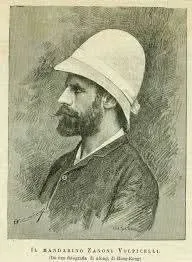
However, following this mission, the weekly magazine L’illustrazione Italiana published an article on Volpicelli, accompanied by a photograph of him; he was also awarded the Double Dragon (Shuanglong baoxing) honour by the imperial court, and even hoped, though in vain, to receive the Legion of Honour from the French government.
In the years that followed, while continuing to serve with the Chinese Customs Service, he travelled several times to China, Japan and Russia. In addition to his prolific work as a contributor to foreign newspapers published in China (in particular the British weekly in Shanghai, *The North-China Herald*), between 1888 and 1893 he published several articles in the *Journal of the North-China Branch of the Royal Asiatic Society*—the leading British journal on Sinology – on subjects as diverse as they were rarely covered.
He introduced Chinese chess (Weiqi or Wei-ch’i, better known in the West by the Japanese term Go) to the European public for the first time, described the use of steam for propulsion in ancient China, and compiled a summary of relations between Portugal and China. During a trip to Italy, on 14 February 1891, he married Iside Minetti in Milan, the daughter of Clementina Pandiani and a member of a wealthy family of Milanese intellectuals, related to the Maraini family from whom the famous orientalist Fosco and his daughter, the writer Dacia, would later descend.
On his return to Shanghai in 1892, he was appointed honorary secretary of the Chinese branch of the Royal Asiatic Society, the leading scientific society for Chinese studies. In 1896, he published in London, in English, *The China-Japan War…*, a reportage – signed under the pseudonym Vladimir – on the Sino-Japanese War of 1894–1895, which ended with the defeat of the Chinese Empire; in this text (translated into Korean in 2009), Volpicelli drew on sources in Chinese, Japanese and various European languages, succeeding in offering a highly comprehensive account of the war.
During those years, he also devoted himself to the study of Classical Chinese phonology and to methods for reconstructing the ancient phonological system and rhymes, being among the first to employ dialectal pronunciations as a useful tool for reconstructing the most ancient forms of speech; he devoted his monograph *Chinese phonology…* to these topics, published in Shanghai in 1896—and fully translated into Chinese in 2003—which Luo Changpei, the most distinguished modern Chinese scholar of classical phonology, considered one of the first scientific works on ancient Chinese phonology. Also in Shanghai, in 1897, Volpicelli published a pamphlet (*The silver question in China…*) on the circulation of silver in China and the dynamics of its fluctuations in value.
After studying Russian in Shanghai, on 3 July 1897 he set off on a long journey to Russia, at the end of which, in 1899, he published, again in English and still under the pseudonym Vladimir, a weighty volume (*Russia on the Pacific and the Siberian Railway*) on Asian Russia and the importance that the construction of the Trans-Siberian Railway had had for the region’s development.
Probably thanks to the prominence of his publications and his frequent trips to Italy, which allowed him to maintain close political ties, finally, after 17 years, on 1 April 1899, he resigned from the Chinese Customs Service – where he had in the meantime risen to the rank of second-class official (Er deng bangban)—to take up a role in Italian diplomacy, which he had so longed for, not without having considered taking legal action against Hart – who was, as already mentioned, the Director of Customs – to claim a supplement to the salary he had received.
Guido Amedeo Vitale, Baron of Pontagio (see the entry on him in this Dictionary), a third-class interpreter at the Italian legation in Beijing (and unanimously celebrated for his linguistic skills), was dismayed to learn that on 15 February 1899 Volpicelli had been appointed directly as a first-class interpreter at the legation in Beijing and, shortly afterwards, by royal decree of 16 February, as regent of the consulate in Hong Kong, a post which also included jurisdiction over the city of Canton and the provinces of Guangdong, Guangxi, Fujian and Yunnan.
Vitale criticised Volpicelli’s qualifications and asked the Ministry in Rome ‘to at least grant him the satisfaction of competing with Volpicelli and taking part in a noble contest, in which neither career progression nor services rendered, but talent and knowledge would determine who should be the first and who the second Chinese interpreter in Beijing’ (Letter from Vitale di Pontagio, 10 April 1899, in the MAECI Archive, ref. IX-V2, f. 40).
Vitale’s protests were in vain, and Volpicelli (who had meanwhile returned to Italy) left Naples on 5 April 1899 to take up his post in Hong Kong with the rank of consul, not without attracting criticism from the Italian merchant Ugo Nervegna, who had previously held the post as honorary consul and had later been at the centre of a fraud dispute.
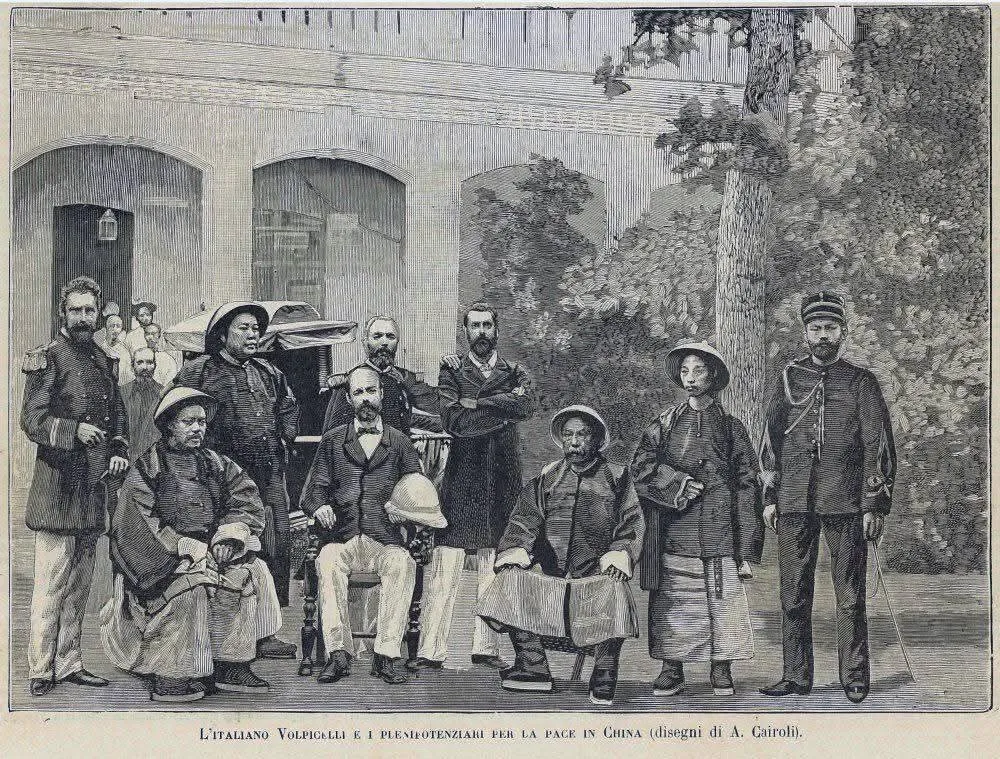
It was a turbulent period for China: the following year, the xenophobic Boxer Rebellion reached its peak, and in June the foreign legations quarter in Beijing was placed under siege. Shortly before this, Volpicelli, thanks to his Chinese contacts, met the Marquis Li Hongzhang, head of imperial diplomacy, who was passing through Hong Kong on his way to Canton; Li suggested to Volpicelli that Italy should also open a permanent representative office in Canton.
The siege of the legations ended with the Boxer Protocol, signed in Beijing on 7 September 1901, which imposed heavy indemnities on China and, among other things, granted Italy a plot of land on the outskirts of the coastal city of Tientsin (now Tianjin), where the first Italian concession in China was to be established.
The activities carried out by Volpicelli during the uprising earned him the rank of Officer of the Order of the Crown of Italy in 1901. In the same year, he returned to Italy by sea, crossing both the Pacific and the Atlantic; he returned to Hong Kong in 1902.
On 18 June 1902, he was appointed Consul General in Hong Kong, with jurisdiction also extending to the cities of Fuzhou and Amoy.
On 1 December 1902, he set off again for Italy. During the journey, he stopped in Hanoi, where he took part in the first International Congress of Far Eastern Studies as one of the Italian delegates (appointed by the Ministry of Education); Francesco Lorenzo Pullé (see the entry on him in this Dictionary) and Lodovico Nocentini also attended the conference on behalf of Italy.
On that occasion, Volpicelli asked the Secretary-General for Indochina, Charles Edmond Hardouin (Letter from Volpicelli to the Minister of Foreign Affairs dated 6 January 1903, re: Hanoi Congress, in the MAECI Archive, file no. IX-V2, f. 41) to advocate on his behalf for the Legion of Honour, in recognition of the services he had rendered during the mission to Tonkin in 1885; in response, he was awarded the Ordre du Dragon d’Annam, a ‘colonial’ honour which he returned in disgust (Report to the Minister for Foreign Affairs, dated 22 December 1907, in the MAECI Archives, ref. IX-V2, f. 41). In 1907, he resubmitted his request to the Ministry of the Colonies in Paris, for which he received a formal reprimand from the Minister for Foreign Affairs, Tommaso Tittoni.
In 1903, he was appointed Knight of the Order of St Maurice and, a few months later, Commander of the Imperial Austrian Order of Franz Joseph (Kaiserlich-Österreichischer Franz-Joseph-Orden).
In 1904, he welcomed to Hong Kong the Russian sailors whom the Italian cruiser Elba had rescued on 9 February in the waters off Incheon in Korea, after the Russian cruiser Varyag had scuttled itself rather than surrender to the Japanese navy at the start of the Russo-Japanese War (1904–1905). For this initiative, he was awarded the Order of St Stanislaus (Order Świętego Stanisława), a Polish honour granted by the government of the Russian Empire.
In early December 1904, he launched a movement to abolish torture in China, securing the support of several foreign residents in Hong Kong, including Sir Henry Spencer Berkeley, Attorney-General of the British colony. On 12 December, Volpicelli organised a meeting at the Italian consulate, chaired by Luigi Amedeo of Savoy-Aosta, Duke of the Abruzzi, who was passing through Hong Kong.
The movement succeeded in attracting the attention of the Chinese authorities in Canton, partly thanks to Volpicelli’s publication – at his own expense and in a print run of around 500 copies – of a Chinese-language version of Chapter XVI (On Torture) of Cesare Beccaria’s work On Crimes and Punishments (1766 edition); the printed text also contained a short preface by Volpicelli, dated January 1905, on the importance of Beccaria’s work and the history of its widespread circulation in Europe, thus becoming the first text in Chinese dedicated to the famous Italian jurist.
On 6 October 1905, following pressure from Deputy Michele Torraca, a member of the Council of State (see the entry on him in this Dictionary), and despite reservations raised by the Ministry of Foreign Affairs, he was awarded the title of Commander of the Order of the Crown of Italy, partly in recognition of his efforts to abolish torture in China and his proposal to establish a Marconi radio-telegraphic system between Hainan Island and Guangdong Province.
In 1906, he was also appointed Italian consul to Macao; in August, he travelled to Italy. During those years, he assisted Italian entrepreneurs in China, such as the Milanese industrialist Adolfo Ghella, who in 1907 had Italian miners excavate the tunnel under Beacon Hill, the main one of the five tunnels built along the British-owned railway line between Hong Kong and Canton. In the spring of 1911, he returned to Italy via the Trans-Siberian Railway, travelling first through Shanghai.
He returned to Hong Kong shortly before the outbreak of the Great War (July 1914). Subsequently, he appears to have been accused of pro-German sympathies – and later also of spying for Germany – by the British Governor of Hong Kong, Sir Francis Henry May, who is said to have requested his recall (no definitive information is yet available on this matter). In any case, immediately after the end of the war, the Italian Ministry of Foreign Affairs decided to transfer Volpicelli first to Canton and then to Rome (Telegram of 21 November, in the MAECI Archive, ref. IX-V2, f. 41), though not without first proposing him as a teacher of Chinese at the Istituto Orientale in Naples (where he is recorded as a lecturer for the years 1918–1919, but where he never took up his post).
On 14 February 1919, Volpicelli gave a lecture in Canton on Dante and Beatrice. On 18 June of that year, he left Canton for good; he then ‘covered his tracks’ with the Ministry, for, without informing Rome of his movements, he undertook a sort of long farewell pilgrimage through China, visiting temples and mountains. At the beginning of 1920, he was in Shanghai, where he received a letter in English dated 25 January, in which Sun Zhongshan – the first president (1911–1912) of the Republic of China, known in the West as Sun Yat-sen – expressed his appreciation for the service rendered by Volpicelli as consul in Canton.
On 3 February, Volpicelli finally left China, travelling from Shanghai to Nagasaki; he stayed in Japan for several weeks, visiting the sacred sites of Buddhism. On 3 March, the Ministry even had to write to Volpicelli’s wife to enquire after him, but a few days later, the Italian Embassy in Tokyo informed Rome that he was in Kyoto.
Passing through the United States, Volpicelli finally returned to Italy; in Rome, he went to visit his ailing wife, Iside. On 3 June 1920, he was placed on leave by the Ministry, and from 1 May 1921, he was placed at the Ministry’s disposal. During the summer of 1921, he was on secondment to the Istituto Orientale in Naples, but, dissatisfied with his position as a teacher, he attempted to secure another post abroad, until in July 1922, on the pretext of arranging for the shipment of his personal effects, he set off again for Canton and Hong Kong (Letter to the Minister for Foreign Affairs, dated 7 February 1922, in the MAECI Archives, ref. IX-V2, f. 41).
He spent the last decades of his life travelling ceaselessly across the continents.
In both 1923 and 1924, he spent a month in Moscow and subsequently published an article in a Chinese newspaper expressing pro-Bolshevik sympathies (The China Press, 31 January 1926). In 1924, his sister Isidora wrote to the Ministry of Foreign Affairs to enquire about him, having lost track of him since 1922 (Letter dated 24 February 1924, in the MAECI Archive, ref. IX-V2, f. 41).
In January 1926, Volpicelli passed through Shanghai on his way to Macao. In China, in the late 1920s, he made contact with leading cultural figures. For example, on 12 July 1928, he met Hu Shi – a poet, philosopher, historian, and literary critic who was radically reforming the Chinese written language, to whom he showed his 1896 monograph on classical Chinese phonology, his 1905 translation of Beccaria, and Sun Yat-sen’s letter from 1920. On 23 and 24 April 1929, he met the Zhejiang monk Taixu – a great reformer of Chinese Buddhism, known as Taixu – who described Volpicelli in his diary as ‘a rather eccentric and peculiar person’ (Taixu dashi quanshu [Complete Works of the Great Master Taixu], XXXI, 2005, p. 353).
In early 1930, Volpicelli was in Mexico, where he became interested in the country’s political affairs, intending to devote a book to the subject. There, he wrote a memorandum dated 20 March, in which he asked the Foreign Ministry for redress after being misjudged by the British Governor of Hong Kong and constantly spied on by the British government. Although he was now retired, he requested to be appointed Italian ambassador to Moscow for six months, so that he could retire definitively with the benefits appropriate to that rank (Letter from the Royal Minister of Italy in Mexico, Comm. Gino Macchioro Vivalba, dated 29 March 1930, in the MAECI Archives, file IX-V2, f. 41). He then stayed in the United States, once again leaving no trace. Later, he appears in Japan, where he seems to have spent most of his final years and where he died, in Nagasaki, on 19 November 1936. His grave in the foreign cemetery was destroyed by the explosion of the US atomic bomb on 9 August 1945, but during the 1950s his headstone was restored, thanks to the intervention of an anonymous Chinese benefactor, so that even his mortal remains, like much of his life, remain shrouded in mystery