(Angelo Paratico) Is the tie, a typical men’s accessory, gradually disappearing from the wardrobes of young people? Perhaps so, but the man in charge always needs one to appear credible and strong.
We believe, rather, that as has happened in the past, we will witness the emergence of new types and styles of ties. A return to the bow tie is out of the question, given that it received a lot of bad press in the 1970s and 1980s, and psychologists now confirm that people tend to view those who wear it as liars.
Prehistoric men used to hang the dried testicles of enemies killed in battle around their necks. Perhaps this is the source of men’s unconscious fascination with the tie, as well as the attraction it holds for women? Yet, all things considered, this is a useless accessory, and it is only thanks to an optical illusion that a man wearing it tightly around his neck appears more authoritative, elegant, and slender.

Let’s immediately remove our Croatian neighbors from the tie equation. They insist that it was their invention, during the Thirty Years’ War (1618–1648), when they sent mercenaries to France who wore them. In fact, Croatia has included a day dedicated to the tie in its calendar: October 8.
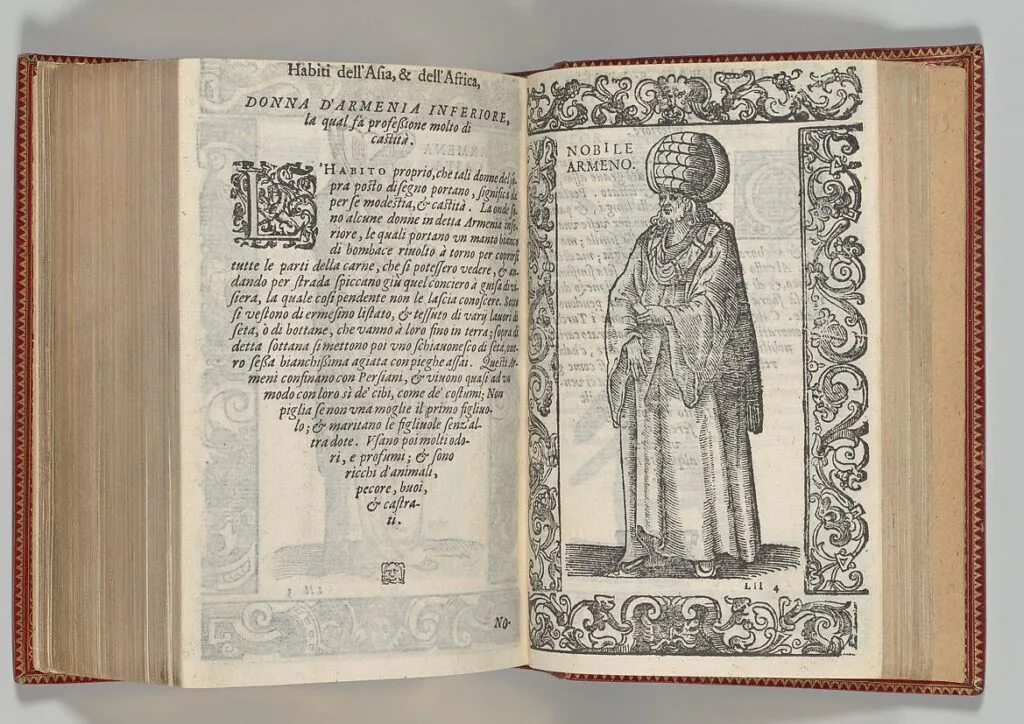
To see that their claim is untrue, we need only leaf through the richly illustrated book by Cesare Vecellio (1530–1601), De gli habiti antichi et moderni di diversi parti del mondo, libri due, published in 1590 in Venice and dedicated to the customs of the world, to find the word “cravatta” written there. And even before Vecellio, Eustache Deschamps (1346–1406), a French poet, wrote a ballad titled “Faite restraindre sa cravate,” meaning “Tie his cravat again.”
A sort of bandana, a Sanskrit term, or cravat, can be seen around the necks of warriors in Xian, China, and also around those of Roman army officers (focale or sudarium, in Latin).
One of the ancestors of modern ties appeared during the Battle of Steinkirk in 1692, in Holland. The English launched a surprise attack, and to rush to the battlefield, the French officers, instead of wasting time tying their bandanas around their necks (a complicated and difficult task, as Lord Brummell demonstrated), tucked the ends into the buttonholes of their lapels: their appearance immediately seemed very attractive and dynamic, and the “à la Steinkirk” style lasted for over a century.
A brief ice age that struck continental Europe from 1645 to 1715, perhaps caused by large sunspots, also contributed to the spread of neckties. Temperatures dropped, and the Baltic Sea froze over, so that one could walk from Poland to Sweden.
This type of embroidered bandana was one of Venice’s main sources of wealth, as the city exported large quantities of them at exorbitant prices for the finest designs. The Sun King was a great collector of these handkerchiefs. The cheaper ones came from India, and in Great Britain, they even passed a law to curb their smuggling and tax them—the Calico Act of 1700.
Pulling a man’s tie in Great Britain was considered a serious crime, with its own specific name, “peanuting,” meaning that the knot becomes as small as a peanut. It is said that tailors make the suits, but men must tie their own ties; this remains a sort of rite of passage into adulthood for all men.
There are three basic knots: Oriental, Half Windsor, and Windsor, but it has been calculated that mathematically there are 85 possible knots, with the latest addition dating back to 1989: the Pratt (or Shelby) knot, a reversed Half Windsor.
The modern tie, similar to the one we wear today, originated in England around 1850, in Macclesfield, Surrey, but it was shorter and wider than the current version. Macclesfield was a major industrial center specializing in silk printing; it was, in a way, the English Como of the 19th century.
The true history of the tie, which was not invented by the Croats
(Angelo Paratico) Is the tie, a typical men’s accessory, gradually disappearing from young men’s wardrobes? Perhaps so, but the man in charge always needs it to appear credible and strong.
We believe, rather, that as has happened in the past, we will witness the emergence of new types and styles of ties. A return to the bow tie is out of the question, given that it received a lot of bad publicity in the 1970s and 1980s, and psychologists now confirm that people tend to see a liar in those who wear it.
Prehistoric men used to hang the dried testicles of enemies killed in battle around their necks. Perhaps this is the source of men’s unconscious fascination with the tie, as well as the attraction it holds for women? Yet, all things considered, this is a useless accessory, and it is only thanks to an optical illusion that a man wearing it tightly around his neck appears more authoritative, elegant, and slender.

ors from the tie equation. They insist that it was their invention, during the Thirty Years’ War (1618–1648), when they sent mercenaries to France who wore them. In fact, Croatia has included a day dedicated to the tie in its calendar: October 8.
To understand that their claim is not true, we need only leaf through the richly illustrated book by Cesare Vecellio (1530–1601), De gli habiti antichi et moderni di diversi parti del mondo, libri due, published in 1590 in Venice and dedicated to all the customs of the world, to find the word “cravatta” written there. And even before Vecellio, Eustache Deschamps (1346–1406), a French poet, wrote a ballad titled “Faite restraindre sa cravate,” meaning “Tie his cravat again.”
A sort of bandana, a Sanskrit term, or cravat, can be seen around the necks of warriors in Xi’an, China, and also around those of Roman army officers (focale or sudarium, in Latin).
One of the ancestors of modern ties appeared during the Battle of Steinkirk in 1692, in Holland.
The English launched a surprise attack, and to rush to the battlefield, the French officers, instead of wasting time tying their bandanas around their necks (a complicated and difficult task, as Lord Brummell demonstrated), slipped the ends into the buttonholes of their lapels: their appearance immediately seemed very attractive and dynamic, and the “à la Steinkirk” style lasted for over a century.
A brief ice age that struck continental Europe from 1645 to 1715, perhaps caused by large sunspots, also contributed to the spread of neckties. Temperatures dropped, and the Baltic Sea froze over, so that one could walk from Poland to Sweden.
This type of embroidered bandana was one of Venice’s main sources of wealth, as the city exported large quantities of them at exorbitant prices for the finest designs. The Sun King was a great collector of these handkerchiefs. The cheaper ones came from India, and in Great Britain, they even passed a law to curb their smuggling and tax them—the Calico Act of 1700.
Pulling a man’s tie in Great Britain was considered a serious crime, with its own specific name, “peanuting,” meaning that the knot becomes as small as a peanut. It is said that tailors make the suits, but men must tie their own ties; this remains a sort of rite of passage into adulthood for all men.
There are three basic knots: Oriental, Half Windsor, and Windsor, but it has been calculated that mathematically there are 85 possible knots, with the latest addition dating back to 1989: the Pratt (or Shelby) knot, a reversed Half Windsor.
The modern tie, similar to the one we wear today, originated in England around 1850, in Macclesfield, Surrey, but it was shorter and wider than the current version. Macclesfield was a major industrial center specializing in silk printing; it was, in a way, the English Como of the 19th century.