(Angelo Paratico) Make a note in your diary that on 13 April 2929 you’ll need to be in a safe place, if possible in an underground bunker. In fact, 99942 Apophis, a large asteroid, is expected to streak across the sky at a speed of around 45,000 kilometres per hour and will be visible to the naked eye even in Europe. Scientists say the risk of impact will be very low, but this is subject to gravitational variations that we cannot completely rule it out.
Apophis was discovered on 19 June 2004 by the Kitt Peak National Observatory in Arizona by Roy A. Tucker, David James Tholen and Fabrizio Bernardi, as part of the asteroid research project funded by NASA and the University of Hawaii. In December 2004, it caused some alarm because calculations predicted it would collide with our planet in 2029, with a probability of 1 in 37. This estimate was subsequently revised, and the latest forecast is that it will pass between the Moon and the Earth on 13 April 2029.
‘(99942) Apophis’ takes its name from the Greek name for the ancient Egyptian god Apopi, known as ‘the Destroyer’, the nemesis of Ra, who dwells in the eternal darkness of the Duat, the underworld, and attempts to destroy the Sun during its cyclical nightly passage. Although the reference to the Egyptian mythological deity may be accurate, it is worth noting that Tholen and Tucker (two of the asteroid’s co-discoverers) are fans of the science fiction television series Stargate SG-1. In the early seasons of the series, the main antagonist was an alien bearing the name of the Egyptian god Apophis, who repeatedly attempted to attack Earth.
On 30 December 2009, the head of the Russian space agency, Anatoly Perminov, announced his intention to convene an international summit to assess a mission aimed at destroying the asteroid, as the effects it might have caused would have been so disastrous as to warrant direct intervention to avert even the slightest possibility.
Extremely precise radar observations carried out at the Arecibo Observatory on 27, 28 and 30 January further refined the orbit and showed that, during the close encounter in April 2029, Apophis would pass at a distance of just 5.6 Earth radii – roughly half the distance previously estimated.
Consequences in the event of an impact
One estimate puts the impact’s yield at 870 megatons (approximately 65,500 times the Hiroshima bomb). If it were to strike, it would be in the East, affecting Australia and China, but this would cause a global catastrophe, with hundreds of millions of deaths, although it would not mark the end of human civilisation.
Possibility of deflection
The ESA estimated that a modestly sized mission could have been sent to strike the asteroid, causing a change in its orbit sufficient to avoid the impact. Researchers from the Advanced Concepts Team identified a very wide range of launch windows for an effective mission. The ESA mission known as Don Quixote was pioneering in this respect, as it set out to demonstrate the possibility of deflecting certain classes of asteroids using the kinetic impact technique, which many consider the most suitable approach even for the hypothetical case of Apophis.
Characteristics
Apophis belongs to the Aten group of asteroids, minor bodies whose orbit has a semi-major axis of less than one astronomical unit. Apophis, in particular, orbits the Sun with an orbital period of approximately 323 days, and its orbit causes it to cross Earth’s orbit twice during each revolution.
Based on its observed brightness, its diameter was initially estimated to be approximately 415 metres; a more precise estimate indicated a diameter of around 320 metres and a mass of 4.6×10¹⁰ kg. Further estimates have reduced the diameter estimate to around 270 metres. Its surface gravity is estimated at 0.0023 cm/s².
An appeal to Elon Musk
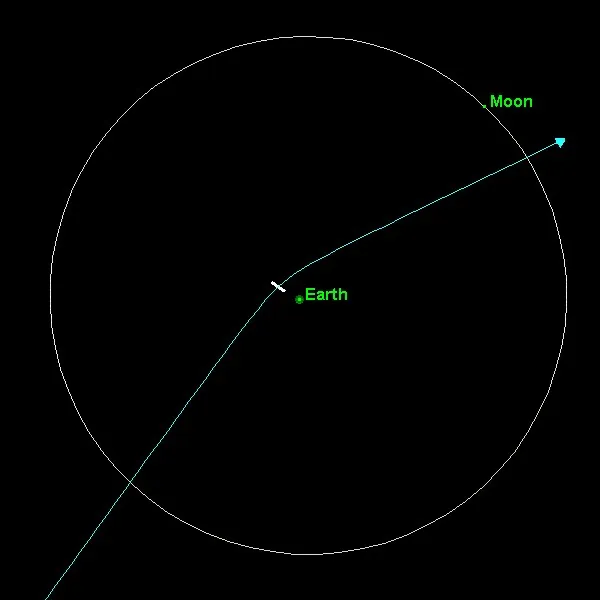
The most significant astronomical event linked to Apophis will occur, as mentioned, on 13 April 2029, when it will reach its closest approach to Earth. At that moment, it will pass just 32,000 kilometres from the Earth’s surface, a distance shorter than that of many geostationary satellites. Earth’s gravity will significantly affect its orbit, altering its future trajectory. Although current calculations rule out an impact with Earth in the coming decades, astronomers continue to study how Earth’s gravity might alter its course and whether this could pose a risk in the future. It will pass by again in 2036 or 2068, but will be further away than in 2029. The European Space Agency is considering launching the RAMSES mission in 2027, which would reach Apophis before its close approach to Earth to analyse the behaviour of its surface under Earth’s gravitational influence.
So, let’s conclude with an appeal to Elon Musk to step in with his SpaceX and organise the launch of a nuclear bomb – as we’ve seen done in certain science-fiction films – to blow that flying monster to smithereens and ensure it no longer poses a present or future risk to Earth.