By Donatella Dal Maso
The story of a legendary pizzeria, where the art of Neapolitan pizza-making has been passed down through three generations
At Salvatore’s, every pizza has always been made according to the traditions of Naples.
Salvatore’s extraordinary pizzas have been part of my life for as long as I can remember. When I was a young girl, I lived with my parents on the sixth floor of a building in Via Vasco de Gama, as did the Rasulo family, who occupied the other wing. They owned a white BMW that I could recognise wherever it went. Whenever Salvatore, the father of the family, spotted me, he would sound his horn with two mighty blasts.
He was a genuinely kind-hearted, exuberant man, and I remember him as a remarkable craftsman of Neapolitan pizza.
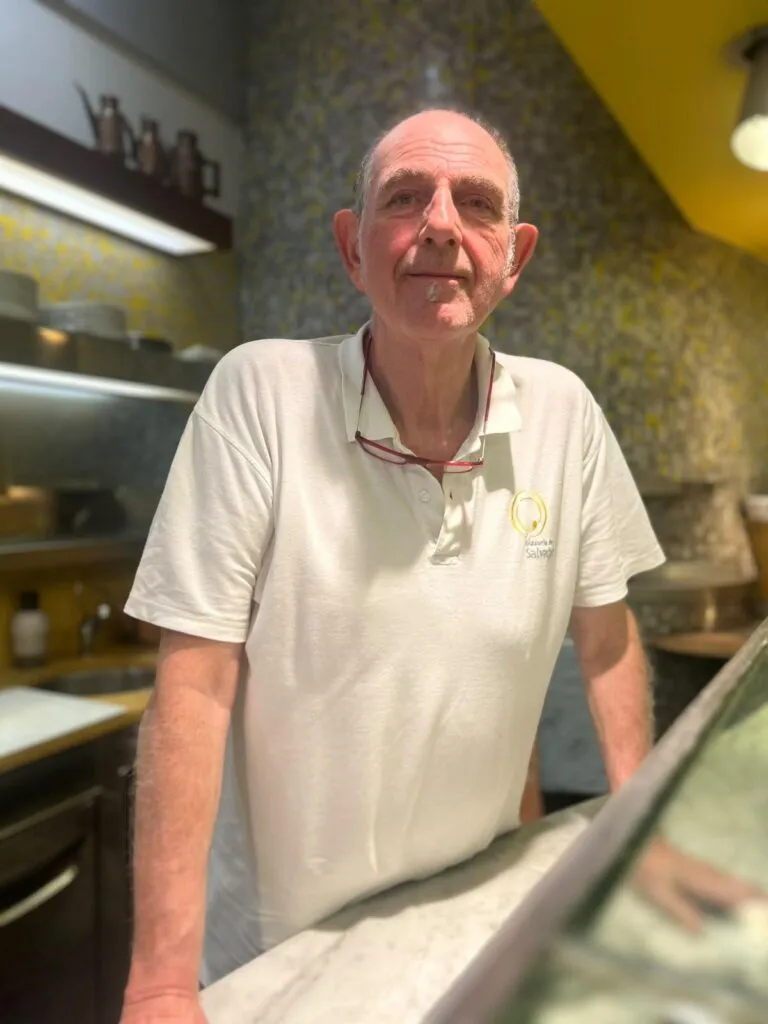
In 1961, Salvatore Rasulo opened his first restaurant in Verona, in Corso Porta Borsari, under the name Salvatore. In the 1970s, his son Ivan, born in 1957 and a qualified surveyor, began helping him run the pizzeria. In time, the business passed into Ivan’s hands.
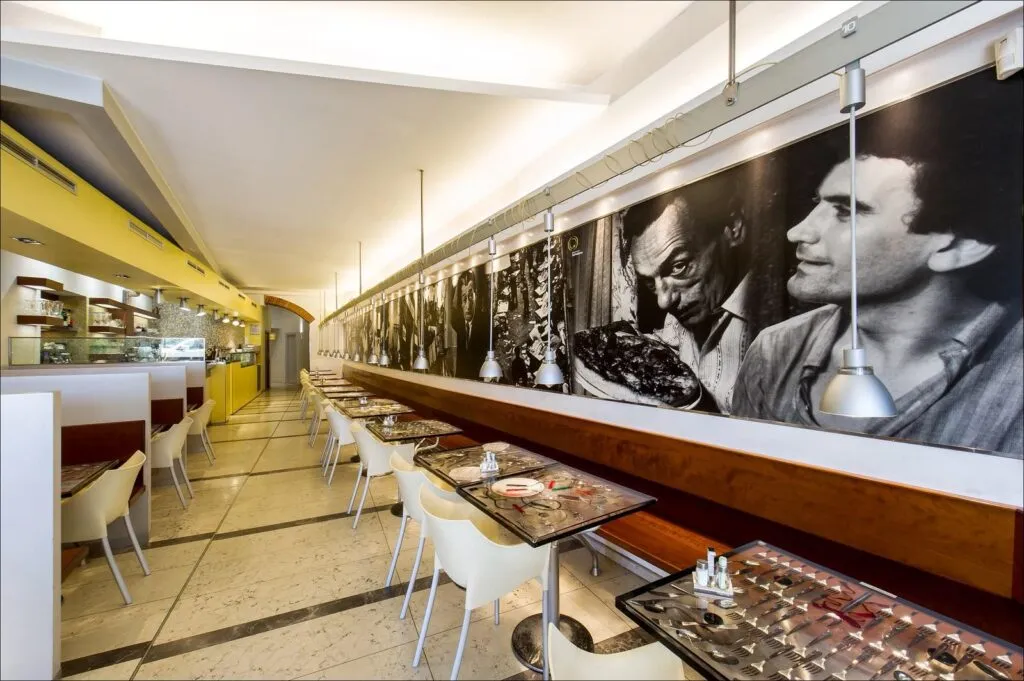
In 2000, Ivan moved the restaurant to Piazza San Tommaso 6, in Verona’s Veronetta district. The architect Giampaolo Canevaro designed a decidedly unconventional and distinctive pizzeria, incorporating some strikingly innovative features, including resin tables embedded with objects salvaged from the original premises.
The pizzas have always remained true to the Neapolitan tradition: tall, wonderfully soft and baked in the oven. A highly hydrated dough, given a long period to mature, has become Ivan’s signature. The menu changes with the seasons, but when it comes to a Margherita crowned with fresh basil, he remains an uncompromising traditionalist.
The extraordinary aroma of his pizzas fills the restaurant and lingers in the air, reaching us before the first bite. By then, we are already eager to savour what many consider the finest expression of Italian cuisine.
‘Your pizza with spicy salami and mushrooms is irresistible’
I have to confess: your pizza topped with spicy salami and mushrooms is enough to drive me wild. I have noticed that other customers, too, always order the same one. Are there many of us who stick to our favourite?
“There are quite a few customers who have been ordering the same pizza for years. It is certainly a very good one, but it is a shame, because sometimes there are so many other flavours to discover, including some entirely new creations. Still, I suppose people like you are a little set in their ways,” he says with a laugh.
What type of flour do you use?
“I work with soft-wheat flour, including doppio zero — the finely milled Italian flour known as 00 — sourced from a couple of mills. One is Antico Mulino Rosso, in Buttapietra, which produces organic stone-ground flour. I like to blend it with other flours to give my dough greater depth and character.
“Flour is an ingredient that should never be taken for granted. You need to understand its technical properties if you want to avoid using it incorrectly. There is no single answer to the question of which flour makes the best pizza, because the choice depends on the type of dough you want to produce.
“To put it simply, you must begin with the result you want to achieve. Two of the principal variables are the maturation time of the dough and its hydration, alongside the fermentation process.”
How should pizza dough be made? Do you always prepare it yourself?
“The basic method is straightforward: combine the main ingredients — flour, water, yeast and salt, with a little olive oil — and knead until the dough becomes smooth and elastic. It is then left to rise.
“I do most of the work myself, although, when necessary, my colleagues are able to step in.”
How long do you leave the dough to rest, and where?
“Our preparation room is not particularly large, but it is practical and well suited to resting all our doughs. We prepare them a day in advance, allowing them to develop properly.
“Depending on the dough, this can mean anywhere from 12 to 16 hours to 24 to 36 hours. That is when it is at its best and ready to use.”
Which tomatoes do you use?
“I do not rely on a single variety. I use two different types of tomato: Roma and San Marzano. I also add my own fresh tomato pulp, creating a blend that gives us a distinctive colour and consistency.”
And what about the mozzarella?
“I use mozzarella supplied by the Martignoni brothers, from Pastrengo, a historic dairy specialising in cheese made for pizza. They do an excellent job.
“It is a traditional cow’s-milk mozzarella, made using artisanal cheesemaking methods and high-quality milk. Its flavour is fresh and delicate, making it particularly well suited to my pizzas.
“Compared with buffalo mozzarella, it is sweeter, milder and less salty. Its texture is firm yet soft, and generally drier because it contains less whey and moisture. The colour is the familiar milky white, sometimes with a faint straw-yellow hue.
“I am delighted with this mozzarella. My father was already a loyal customer of theirs, so our relationship goes back a long way. We have always tried to select ingredients that help us make the best possible pizza.”
The ingredients are ready. How do you bake your pizzas?
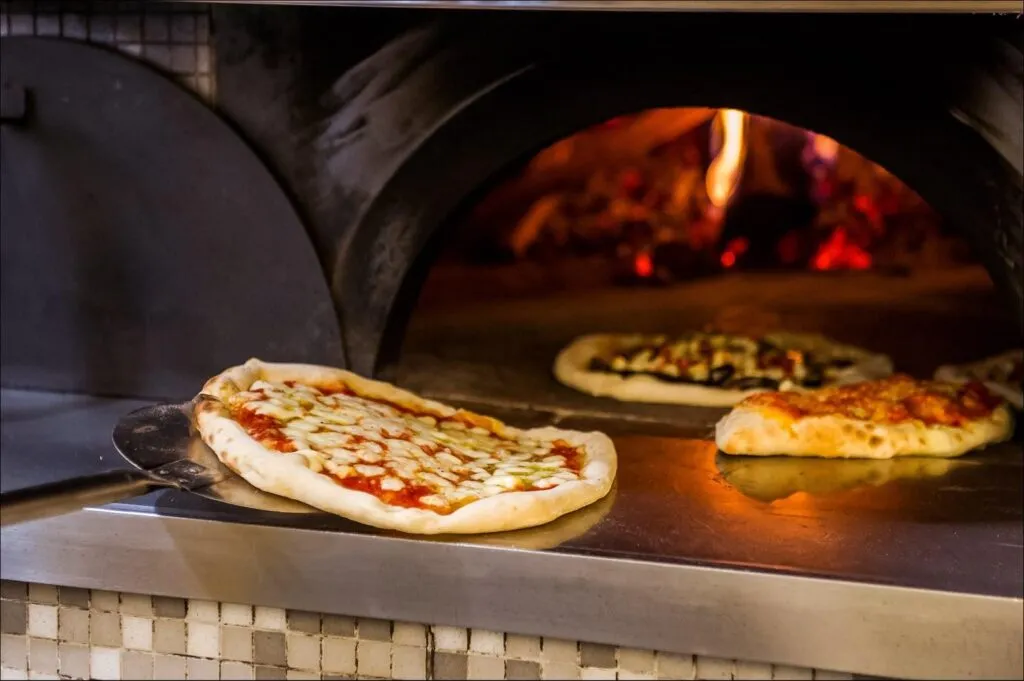
“I use a wood-fired oven, following the method my father taught me, which had in turn been passed down to him by my grandfather, Antonio.
“The cooking surface, known as the platea or suola, is the oven floor. It absorbs heat from below and must be brought up to temperature before baking can begin. You need to keep the fire going, monitor the heat in the dome, allow the temperature to stabilise and check that everything is right.
“The pizza is topped directly on the workbench before being placed in the oven. At temperatures of between 400°C and 450°C, it cooks in no more than a minute and a half to two minutes.
“This is very different from an electric oven, where the temperature is generally kept at a standard setting. I turn the pizza with the peel so that it cooks evenly on the other side. That is when the unmistakable aroma and crisp, fragrant character emerge — qualities you can achieve only with a wood-fired oven.”
Who are the colleagues who work alongside you?
“The two young men who work as pizzaioli are Davide and another Ivan, who happens to share my name. They support me, and I have complete confidence in both of them. Their main responsibilities are managing the oven and helping to top the pizzas.”
Which pizza is Verona’s most famous?
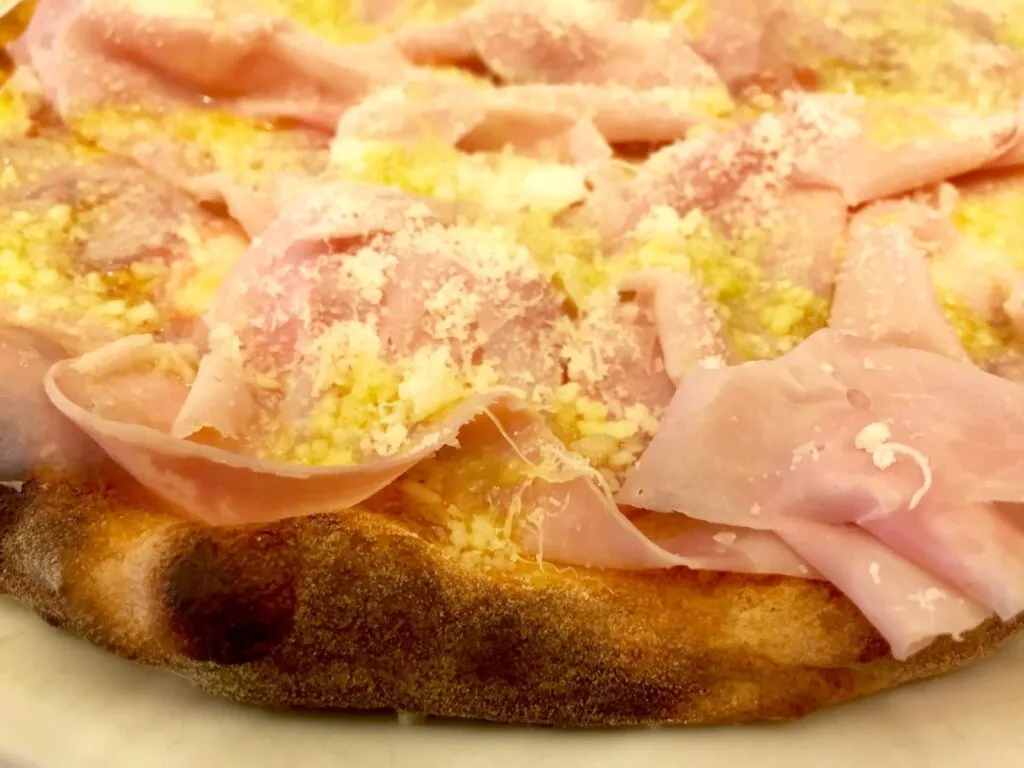
“The most popular is the Calvetti, a pizza created by Claudio Calvetti in the 1970s.
“He was a dear friend of mine and, of course, he knew my father, Salvatore, too. He was certainly a connoisseur of good food, as well as quite a character. He would look at what he called his famous pizza and suggest another way of topping it. His idea was to fill it with ricotta, cooked ham and Parmigiano Reggiano.
“Little by little, the Calvetti was born.
“Since then, many pizzaioli have copied it outside Verona, even in other regions. But the original, in truth, is the one we created here.”
Which other pizzas are favourites with your customers?
“Fresh buffalo mozzarella is very popular, as is smoked buffalo mozzarella with yellow datterini tomatoes. Another favourite is the Capri, which is finished with a tomato sauce added after baking and a sprinkling of Parmigiano Reggiano.
“We like to experiment with new combinations, and we have more than 70 variations on offer. Naturally, we also serve our calzone.
“That is particularly popular because it has a character all of its own. The dough is folded over and sealed, and it takes considerably longer to cook. The result is a more substantial pizza, generously filled with ricotta and very high-quality mozzarella.”
What is your greatest weakness?
“I am probably something of a control freak. I want to do everything myself, and that is not a good thing. At a certain point, I struggle to trust other people to take responsibility for a particular task, even at work.
“I realise, too, that I can be egocentric. I take on too many things in my life, and it leaves me utterly exhausted.
“Running a pizzeria is about much more than simply making a pizza. You also have to deal patiently with all the problems that arise around the business.”
And your greatest strength?
“Without a doubt, it is my passion for this profession. Above all, it is the profound love I have always had for pizza.
“All the sacrifices I have made have been repaid through the affection of my customers and the bond I have built with my work.
“When I think about it, it has truly been worth it.”