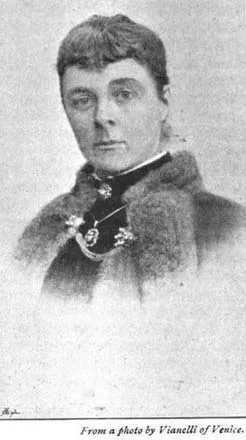
(Angelo Paratico) Alethea Jane Lawley Wiel, an English writer who loved Italy, especially Venice and Verona, she died in London on April 13, 1929, at the age of 77. She was the daughter of the second Baron Wenlock, and her mother was the daughter of the Marquis of Westminster. On Saturday, April 12, 1890, in the Chapel of the Patriarch Cardinal, St. Mark’s in Venice, Alethea married the noble cavalier Taddeo Wiel, one of the librarians of the Marciana, a pioneer of Venetian theatrical chronology, musicologist, and librettist, who died in 1920. Alethea, who chose to live in Italy for health reasons, was fascinated by the beauty of our country. She described it in a series of publications: “The History of Verona,” “The Navy of Venice,” “A History of Venice: From its Foundation to the Unification of Italy and many more. Alethea lived in Venice for many years, staying several times at Villa Pagani-Gaggia in Socchieva (San Fermo, Belluno), where Hitler and Mussolini met in 1943.
The English writer also frequented Villa Corte-De Bona in Salce (Belluno), which at the time was owned by Frederic Eden, great-uncle of British Prime Minister Anthony Eden. Frederic Eden was a well-known figure in Venice during the Belle Époque because in 1884, with his wife Caroline, sister of garden designer Gertrude Jekyll, he purchased a six-acre area measuring 24,281 square meters on the Venetian island of Giudecca. The property was subsequently expanded by another 8,094 square meters, where the couple created a large English-style landscaped garden with statues, roses, and animals, frequented by artists and intellectuals including Marcel Proust, Rainer Maria Rilke, Walter Sickert, Henry James, and Eleonora Duse.
We are publishing here the introduction to her History of Verona:

PREFACE
The story of Verona is not a simple record of a simple town with a continuous rule guiding her fortunes and directing her destinies. Her tale is intertwined with those of other nations and languages; Greek, Ostrogoth, Longobard, and Frank have held sway in Verona, as well as Etruscan and Roman. The influence of these diverse nationalities has left its mark on the art and history of the city to a notable extent. The architecture of Verona alone demands long and deep study, and calls for an expert’s hand to do justice to its varied and beautiful developments. Her school of painting, too, is a subject that has not yet received sufficient attention, and deserves a study which so far has been but scantily bestowed upon it. I have tried, in a humble and limited way, to present to the reader some idea of this school, and to make him familiar with the names, works, and methods of the masters of painting with whom he will most often come into contact during his wanderings through Verona. Many of their masterpieces are found in the grand old churches, which form one of the chief features of Verona, and within whose walls it is well to linger if we wish to grasp fully the character of the town and of the men who raised these noble buildings, and who now lie buried in or beside them. The history of Verona is all-absorbing, but I have tried to give it only the prominence necessary for such an understanding of the town as will interest the traveller and enable him to enjoy a stay amid surroundings that will perhaps no longer seem “foreign” to him.
I have drawn much of my knowledge of the Veronese school of painting from Sir A. Henry Layard’s excellent work, Handbook of Painting. The Italian School; based on the Handbook of Kugler (London: Murray, 1887), which was most kindly lent to me by Lady Layard; and from Mr Selwyn Brinton’s The Renaissance in Italian Art, Part II. (London: Simpkin, 1898). My grateful thanks are also due to Prof. Commendatore Carlo Malagola, Head of the State Archives in Venice, for the loan of books and for assistance in obtaining much of the information I required. I am also indebted to Cav. Giuseppe Biadego, Librarian of the Biblioteca Comunale of Verona, and to Cav. Dr Riccardo Galli for their help during my stay in Verona. Nor must I omit to mention the Hôtel de Londres in that city, where comfort and economy are very happily and successfully combined by a most courteous and diligent landlord. My chief thanks, however, are due to Cav. Pietro Sgulmero, Deputy Librarian of the Library and Deputy Inspector of the Monuments in Verona, who devoted many spare hours to introducing me to every part of the town, and imparting to me as much as he could of his extensive knowledge of the history and legends of his native city. My book owes more to him than I am able to express.
“Few towns,” says Mr Selwyn Brinton, “have an individuality more delightsome than Verona – Verona the Worthy (Verona la Degna) as she was called” – and if I succeed in endearing that individuality and making it familiar to the traveller wandering through this “worthy” and glorious city, I shall not have laboured in vain.
Palazzo Soranzo,
Venice, January 1902.