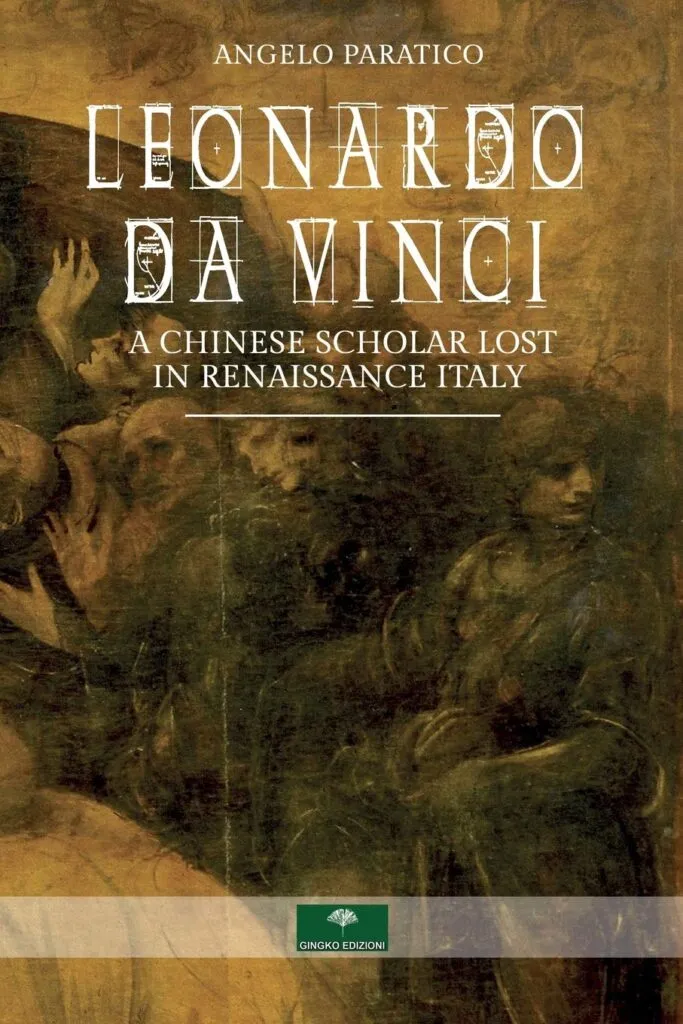
(Angelo Paratico) It is not unreasonable to think that Leonardo da Vinci knew Amerigo Vespucci personally, given that the two were almost the same age. Yet the artist behind the Mona Lisa never showed much interest in America: he was far more drawn to Asia. Evidence of this interest can be found in Leonardo’s body of writings – bearing in mind that around half of this prolific writer’s output has been lost. Some of his sketches appear to have been copied from Arabic manuscripts, such as the famous drawing of the foetus in the womb, whilst others seem to be of Hellenistic origin; perhaps the originals – now partly lost – were circulating amongst his contemporary engineers.
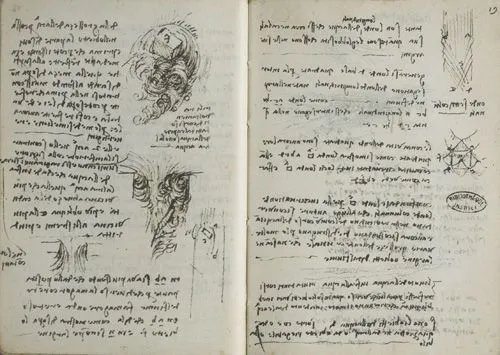
Codex F, preserved at the Institut de France in Paris, is a delightful notebook that Leonardo carried in his pocket. It was stolen from the Biblioteca Ambrosiana in Milan in 1796 by Napoleon and was never returned.
On the reverse of the cover, we find a curious line of writing:
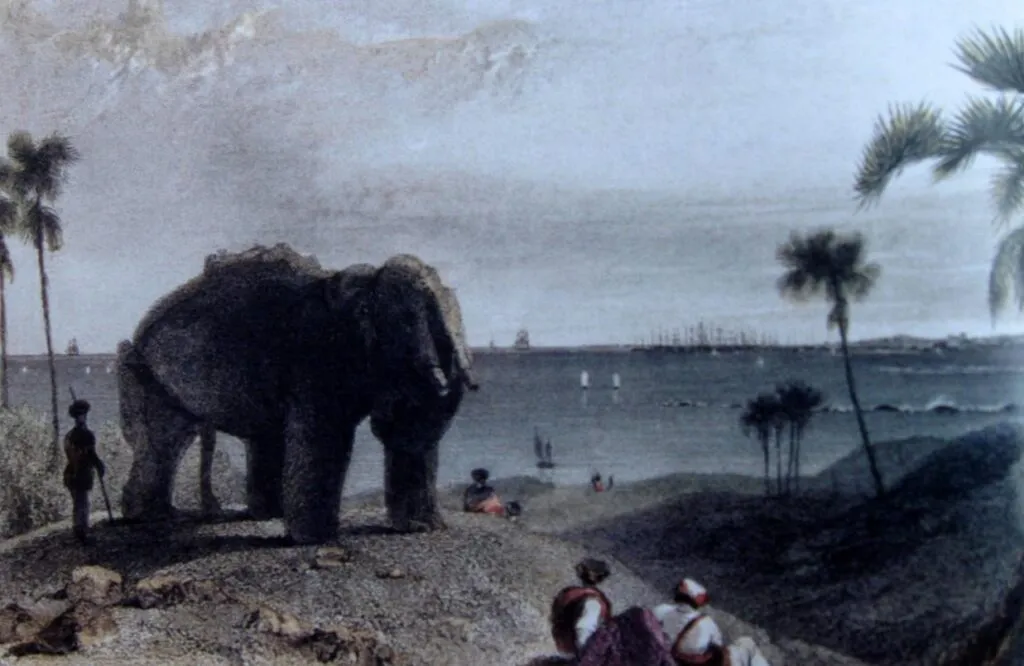
Piāta d’Ellefante djndja che’lla Antonello/merciaio
‘A map of Elephant in India owned by Antonello the haberdasher. This notation was fully understood when it was discovered that a place called ‘Elefante’ by the Portuguese actually exists. It is the small island of Garapur in Mumbai Bay, where there once stood a large basalt statue depicting an elephant alongside various statues of Hindu deities, which were later vandalised. India also features in his geographical notes, such as the mountain ranges of Central Asia, from the Caucasus to the Himalayas, and the great river basins of the Indus and the Ganges; all this information was derived by him from ancient authors, such as Ptolemy. We also have a note in which he mentions the custom of certain Indian religious figures of eating wooden fragments of their own deities.
The explorer from Empoli, Andrea Corsali (1487–?), sent two lengthy reports to Giuliano de’ Medici, son of Lorenzo the Magnificent and brother of Pope Leo X, as well as patron of Leonardo da Vinci. This is what he wrote on 1 January 1516:
Between Goa and Rasigut, beyond Carmania, there is a land called Cambaia, where the River Indus flows into the sea. It is inhabited by pagans known as the Guzzarati, who are great merchants. Some of them dress in the apostolic style, whilst others follow the Turkish custom. They do not eat anything that contains blood; nor do they permit any harm to be done to any living creature, just like our Leonardo da Vinci. They live on rice, milk and other non-living foods.
Corsali is more famous in Australia than in Italy, because in one of his two letters he described and sketched the Southern Cross constellation on a sheet of paper, which we now find on the Australian flag. We do not know the circumstances of his death, but it seems that after India he travelled to Ethiopia in search of Prester John, a country hospitable to visitors – so hospitable, in fact, that it would not allow them to leave.
So, Leonardo was a vegetarian. Since the time of Pythagoras, this way of life has been linked to Asia and, in particular, to the Vedas and Buddhism. We know that even Leonardo da Vinci’s most eccentric and brilliant disciple was a vegetarian, wearing only linen garments. His name was Tommaso Masini da Peretola and he was nicknamed Zoroaster. If it is true that Leonardo attempted to fly, in Milan and Florence, then the pilot of the aircraft was certainly this Zoroaster. There are two categories of vegetarians: those who do not eat meat out of respect for living beings, like Leonardo, and those who do not eat meat because they believe it is harmful. Adolf Hitler belonged to the latter category.
The Portuguese explorations in the Far East were financed mainly with gold florins from the Republic of Florence: Francesco Corbinelli, born in Florence in 1466, married in Portugal the daughter of Bartolomeo Marchionni, a wealthy Florentine merchant associated with Giuliano del Giocondo – one of his relatives had married Monna Lisa Gherardini del Giocondo – and had subsequently moved to Goa, in India; he too wrote a famous account concerning Vasco da Gama’s second voyage.
Leonardo knew several Florentine travellers bound for Asia and perhaps also the young Giovanni da Empoli, employed by the bankers Gualtierotti & Frescobaldi, who undertook no fewer than three missions. The last of these proved fatal: he was born in Florence in 1483 and died of typhus in Canton, China, in October 1517, together with two of his fellow Florentines, Raffaello Galli and Benedetto Pucci.
The bridge that Leonardo wanted to build across the Bosphorus, on a reduced scale.
In the Codex Atlanticus we find a curious account of a journey to Asia undertaken by Leonardo da Vinci. A leading scholar of Leonardo’s work, J.P. Richter, attempted in 1883 to prove that this journey had in fact taken place, in his work ‘Leonardo da Vinci im Orient – Zeitschrift für bildende Kunst’; however, this hypothesis was already refuted by Calvi in 1925 and is no longer taken seriously by anyone today. Among his notes from the journey is a letter addressed to the Diodario, that is, the diwādar of Syria, lieutenant to the Sultan of Babylon – in those days Cairo was called Bailonia – in which Leonardo recounts first-hand his adventures in Egypt,
Cyprus and Istanbul, describing the collapse of a mountain and a tsunami that swept away an Asian city, accompanying his words with marvellous sketches. We also possess the draft of a report he sent to Benedetto Dei (1418–1492), one of the greatest travellers of the time and a Medici spy. Dei was a friend of Leonardo’s, as the two had travelled together from Florence to Milan in 1482. Sigmund Freud, in his famous book on Leonardo’s childhood, interpreted these travel notes as pure amusement, the jest of a cheerful and childlike mind, since, according to the founder of psychoanalysis, Leonardo remained a playful boy throughout his life. Carlo Pedretti, on the other hand, interpreted these writings as the draft of an adventure novel and dated them to 1508. Leonardo was certainly impressed by the travel accounts he read in works from his library, such as the *Metaura* from the *Aristotile Volgare*, a work by John Mandeville, printed in Milan in 1480; Priscian’s *De Situ Orbi* and Pliny’s *Naturalis Historia*; and perhaps he wished to emulate them. Thus, it would appear to be merely a figment of his imagination, although with Leonardo da Vinci there is no shortage of surprises. One example of this is the story of the bridge over the Bosphorus that appears amongst his papers, which was also once thought to be a product of his imagination. In 1957, Franz Babingher, a scholar at the University of Göttingen who was researching material for a biography of Sultan Bayezid II, discovered in the Topkapi Archives in Istanbul that correspondence had in fact been exchanged between the Sublime Porte and Leonardo da Vinci. In 1502, Leonardo proposed the construction of a bridge with a single span 240 metres long and 24 metres wide. Fortunately, nothing came of it, because with the materials and construction techniques available at the time, a catastrophic collapse would have been a distinct possibility.