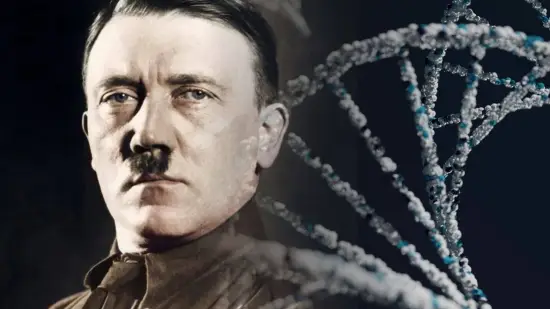
(Angelo Paratico) At the end of 2025, newspapers around the world reported that Adolf Hitler had suffered from Kallmann’s syndrome and that this had, in some way, shaped his character and behaviour.
These findings appeared to have a scientific basis because the researcher Turi King of the University of Bath had analysed a piece of the upholstery from the sofa on which Hitler had shot himself. One of the most remarkable aspects concerns the way in which it was possible to analyse that sample of Hitler’s DNA. Colonel Roswell Rosengren of the US Army, one of General Eisenhower’s press officers, managed in May 1945 – during a visit to the Führerbunker authorized by the Soviets who had occupied Berlin – to retrieve a bloodstained piece of fabric from the sofa where the Nazi dictator had taken his own life a few days earlier by shooting himself in the head. However, there are doubts surrounding the entire study, starting with the sample containing traces of Hitler’s blood and whether it actually matches the dictator’s blood: the piece of fabric was, incidentally, found decades later in the American museum in Gettysburg. However, the researchers were unable to obtain a fresh DNA sample from any of Hitler’s living descendants in Austria and the United States, all of whom were understandably reluctant to be in the media spotlight. The findings were not immediately peer-reviewed, but were the subject of a two-part documentary broadcast by Channel 4 entitled ‘Hitler’s DNA: Blueprint of a Dictator’.
Kallmann’s syndrome
One of the many symptoms of Kallmann’s syndrome is said to be the failure of the penis to develop and the failure of the testicles to descend into the scrotum. Still, the most obvious symptom is said to be the lack of a sense of smell in those affected, yet Hitler had an excellent sense of smell and was able to grow a beard and moustache; furthermore, the pitch of his voice was very low in the only known recording in which he speaks normally, suggesting that he had reached puberty. His doctor Erwin Giesing, his personal physician Theodor Morell and his childhood pediatrician Eduard Bloch all stated that Hitler’s testicles were normal.
Both the analysis and its presentation in the documentary have been criticised by several geneticists and science writers as speculative and overly sensationalist; some have joined the presenters in warning against biological determinism and attributing excessive importance to polygenic risk scores.
A 2008 study published in the European Journal of Human Genetics examined a large group of patients with Kallmann syndrome. The researchers found that people who clearly exhibited the condition were those carrying two defective copies of the PROK2 gene, whilst individuals with only one defective copy (such as Hitler) appeared completely healthy.
Two defective copies, or other defective genes related to pubertal development, are required for Kallmann syndrome to manifest. And many perfectly normal and fertile people carry the same type of single-copy mutations found in Hitler. Given that this conclusion comes from professional geneticists, it seems like an incredible misinterpretation of their own findings, which the media have further sensationalized.
Whilst the Jewish ancestry of the dictator responsible for the Holocaust has been ruled out – another aspect that has been at the centre of speculation and suspicion for decades.
The evidence that Hitler’s genitals were normal is a key detail that everyone has overlooked.
Adolf Hitler enlisted in the German army in August 1914; the penises and genitals of volunteers and conscripts were examined with Teutonic thoroughness during the medical examination for conscription. At the start of that terrible war, there were a great many volunteers, as they believed they would win within a matter of weeks, and so the examiners could afford to reject those they did not deem fully fit.
The examination of the male genitalia was standard practice, strictly codified by the German Empire’s military medical regulations. Military doctors carried out this visual and manual inspection for both anatomical and health-related reasons. The reasons for inspecting the genitals were not moral in nature, but strictly practical and operational, aimed at assessing fitness for frontline service. The identification of sexually transmitted diseases, such as syphilis and gonorrhea, was crucial because they could decimate the combat effectiveness of entire units. Doctors looked for sores, ulcers, or suspicious secretions. They checked for malformations or physical conditions and were required to report conditions such as hydrocele (accumulation of fluid in the testicles), inguinal hernias, and severe phimosis. Under the strain of long marches or carrying heavy equipment, these conditions would have rendered a soldier immediately unfit for service, thereby endangering his entire battalion. Epidemiological prevention, involving the isolation of infected individuals before they were sent to barracks or the trenches, was the only way to prevent mass infection.
Candidates were required to undress completely in front of the medical board. The palpation of the testicles and the request to expose the glans to check for phimosis or infections were experienced by many young men as a deeply humiliating ordeal, due to the total lack of privacy. This type of examination was not limited to initial conscription, because once at the front, soldiers were periodically subjected to unannounced genital inspections to monitor hygiene and the development of infections contracted in brothels or from independent sex workers.
If Hitler had had any penile malformations, as King would have us believe to prove her preconceived theories, he would certainly have been rejected. Genetics or psychiatry have nothing to do with Hitler’s rise to power, because it was Germany that created Hitler, not Hitler who created that Germany.