(Angelo Paratico) Sixty-five years ago, a Chinese electronics engineer, director of the Olivetti research centre, was sitting in the back seat of his Buick. He had asked his young chauffeur to drive at full speed from Ivrea to Milan. As usual, he was in a hurry, but he had to study some important documents. The weather was bad and it was foggy; they had an accident, colliding with a lorry, and both died. That engineer’s name was Mario Tchou and he was 36 years old. In Italy, his name is still remembered in books and various articles, but not as much as he deserves.
A Chinese Man in Rome
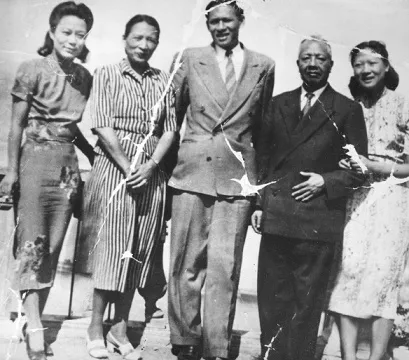
His father’s name was Yin Chou and he had arrived in Italy in 1918 from China in search of textile machinery or a wool mill, but his fate changed when he began working at the Chinese Embassy in Rome. His wife, Evelyn Wang, joined him in 1921; the following year they had their first daughter, Maria, then on 26 June 1924 their first son, Mario, and two years later another daughter, Memè. Evelyn was a revolutionary woman who fought for women’s rights and in 1929 she returned to China for a journey lasting over two years with her children, leaving her husband behind in Italy.
Mario always achieved excellent marks at school: he was a brilliant pupil and, during the parties held at their home, many children from prominent Italian families would play with him. The courtyard of the Chinese embassy was the ideal place to play football, and Mario was part of the team.
Despite the war, in 1945 Mario graduated with top marks from the University of Engineering in Rome, and his father sent him to the United States on a scholarship. In 1947, he obtained a degree in electrical engineering from the Catholic University of America in Washington DC. In 1949, he was awarded a Master of Science from Brooklyn Polytechnic with a thesis on polar diffraction. There he met Mariangela Siracusa, an Italian student at Columbia University, and the two married. The marriage would end a few years later.
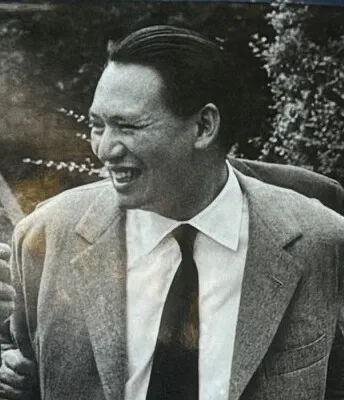
From 1952, he was a lecturer at Columbia and director of the prestigious Marcellus Hartley Laboratory.
In 1954, Mario Tchou met Adriano Olivetti, the young owner of Olivetti, the visionary industrialist at the helm of Olivetti Business Machines. The two men hit it off immediately; it was a sort of love at first sight. Adriano Olivetti had already met the Nobel laureate Enrico Fermi, and both agreed that the future lay in electronics.
The world’s first electronics centre is established in Italy
Mario Tchou shared this vision and agreed to return to Italy, where he would be put in charge of a research team and provided with the necessary funding.
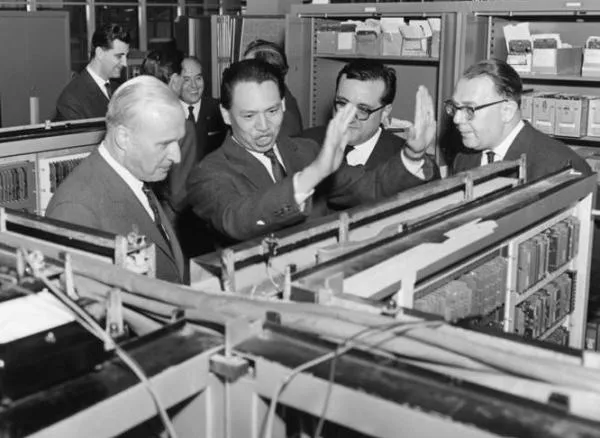
Initially, Olivetti joined forces with the University of Pisa; the group set up shop in a small villa tucked away in the Italian countryside at Barbacina, near Pisa. After a few months, Mario Tchou and Adriano Olivetti felt they could not continue with that arrangement and decided to create an independent research centre, wholly owned by Olivetti. Mario Tchou selected a team of engineers and told a newspaper: ‘It is young people who bring about new things. Only young people throw themselves into things headlong with enthusiasm and work together without egos, in complete harmony and without creating the obstacles that arise from old habits.
They were all Italian, except for one: the Canadian Martin Friedman. One of Mario Tchou’s great strengths was his ability to select the right people and let them do what they did best.
In September 1957, the first prototype of an electronic computer was built: the Model Zero, a name that was later changed to Elea 9001, which operated using vacuum tubes and a few transistors. Seeing that it worked, they decided to proceed with a mass-produced version. It was then that Mario Tchou decided to change course, a choice that proved crucial; one of his engineers, destined for a brilliant career, still recalls it today: ‘That decision was taken during an urgent meeting called by Mario Tchou on a Sunday afternoon in the autumn of 1957. At the time, the transistor was a component used only in laboratories, and its use was extremely risky and could have caused a delay of a year. This was clearly explained by Mario Tchou during his introduction, but he told us that he had decided to proceed in this way. This decision clearly demonstrates his forward-thinking vision. He was a leader and a visionary.” It was during this period that his first marriage came to an end and he began a relationship with a young painter, Elisa Montessori, with whom he would have two daughters.
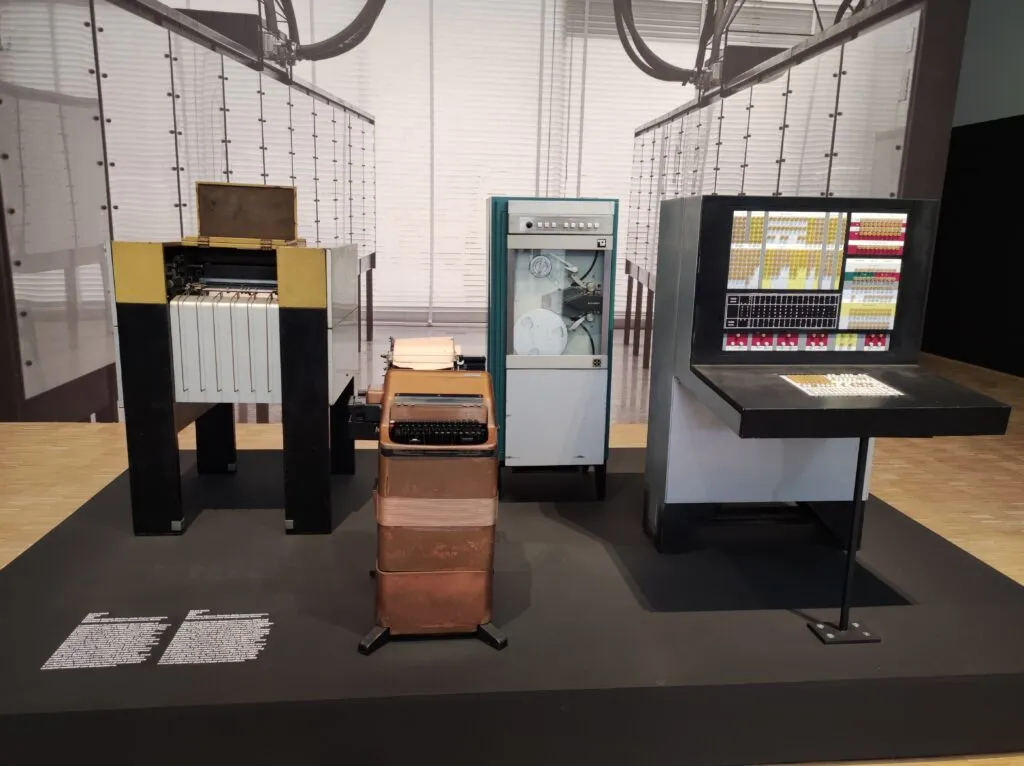
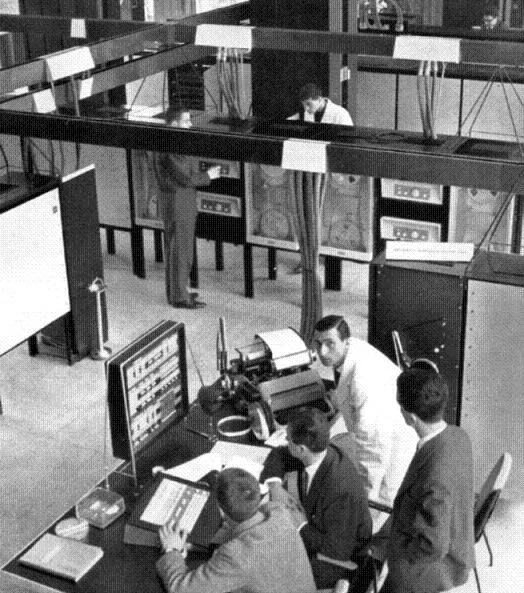
Transistors were not available on the market in sufficient quantities across Europe, so Olivetti set up a new company to manufacture them; that company is still in operation today and is called ST Microelectronics. The new computer was almost ready when they decided to move to new premises in Borgo Lombardo, near Milan. The new supercomputer was called the Elea 9003; it was the size of a tennis court, with a console the size of a fridge. There was only one computer in the world at the time – IBM’s – but the Olivetti machine was technologically cutting-edge, despite having a smaller budget. The project was entrusted to Ettore Sottsass, who was not very well known at the time but is now remembered as one of the greatest names in industrial design; he created a stunning machine that went on to win an award. It was eye-catching and modular. Despite its high cost, the machine’s performance was impressive for the time; large companies placed orders and 35 units were sold. One is still in operation today at a technical college in Italy, where students can literally access its memory and navigate through the RAM. Mario Tchou worked on replacing mechanical controls with electronic controls for machine tools. At the time, it was a totally revolutionary idea.
Lucio Borriello recalls: ‘Mario Tchou entrusted me with the project to build two data recorders for the collection and recording of data from a nuclear reactor at the Latina nuclear power station.’
In 1960, Mario Tchou began work on a new, cheaper and more powerful computer; the result was the Elea 6001, intended for sale to universities and laboratories; between 1961 and 1965, 100 units were sold.
Olivetti is devastated
In early 1960, Adriano Olivetti suffered a stroke and died in a train compartment: a grave loss for the company. At that moment, Mario Tchou decided to change the programming language of the Elea machines, switching from the Fortran used by IBM to the more advanced Algol. That was his last wise decision, and a new computer began to take shape, but Mario Tchou died shortly before its launch. An irreplaceable loss, even though his team of young engineers, led by Piergiorgio Perotto, Mario Tchou’s right-hand man, continued the production of the first desktop computer. It was called Programma 101, also known as the ‘Perottina’, and was unveiled at a trade fair in New York in 1965. On 4 October 1965, the New York Times, the Wall Street Journal, Business Week and the Herald Tribune all ran similar front-page headlines: ‘The world’s first desktop computer’. Hewlett-Packard purchased a hundred units, but then launched a similar product onto the market. Olivetti took them to court and was awarded one hundred thousand dollars in damages for patent infringement.
That marked the end of Mario Tchou’s dream. Olivetti had made a number of strategic errors, such as the acquisition of Underwood typewriters, and few people still believed in the future of electronics. The bankers saved the company, but one of the conditions was the sale of the electronics division to General Electric. And as Vittorio Valletta – who had risen from accountant to head of Fiat, whilst remaining an accountant at heart – put it: “Olivetti’s future lies in mechanics, not in electronics.”