(Angelo Paratico) For many of my generation (we are boomers), Indro Montanelli, with his articles and his view of history, was a source of admiration and respect. When I published a booklet in Hong Kong containing the Sayings of Confucius, the image of the Confucian ‘superior man’ that came to mind was precisely his, and for this reason I dedicated that book to him. After he was ousted from Il Giornale, I was one of the few overseas subscribers who followed him through La Voce’s collapse. One of the first cracks in the monument I had erected to him was caused by Gino Agnese, a writer and foreign correspondent who passed away last year. He told me that, without a doubt, Montanelli had a writing style that made you fall in love with it, but for him, what mattered was not the truth but what seemed plausible, and he cited various examples.
Indro’s lies
I went to check and, with great sadness, had to admit that Agnese was right; the most glaring lies were the image – which he often recalled – of him wandering around Piazzale Loreto on 29 April 1945 and gazing at the mutilated bodies of Mussolini and the others. Yet he remained safe in Switzerland until 22 May 1945. The other big tall tale was the story of his young Abyssinian wife, who existed only in his imagination, as has been proven beyond any reasonable doubt. A low-ranking Italian officer in Africa could not have afforded such liberties.
Renata Broggini, a Swiss historian from Locarno, was something of a nemesis for that tall-tale-teller Montanelli; indeed, after a few exchanges, realising full well where she was heading, he consistently refused to reply to her or meet her. In particular, a book by Broggini, based on meticulous archival research, has shattered Montanelli’s reputation as a careful and credible reporter. The book is *Passaggio in Svizzera. L’anno nascosto di Indro Montanelli* (Feltrinelli, 2007, reprinted in 2021), which, however, had very little impact in Italy. The picture that emerges when re-reading his verbal about-turns is that of a novelist, a sort of Ernest Hemingway who was sent to Europe before the Second World War and then sacked by his newspaper because he tended to produce novel-like plots, with himself at the centre, rather than reliable news.
The escape to Switzerland
On 14 August 1944, Indro Montanelli arrived at the Swiss border, at Costone di Stabio, in the province of Varese. With him were the American Dorothy Gibson, Anna Grella, General Zambon, and a certain Luigi Monti, who was accompanying them. The German guards let them through, turning a blind eye. His wife, the Austrian Margarethe de Colins de Tarsienne, remained in prison. He told the Swiss that he had escaped from San Vittore, thanks to the National Liberation Committee. He passed himself off as a member of the Resistance and later gave various accounts of how he had managed to escape the death sentence, which, in reality, had never existed. Over time, and following the deaths of witnesses who might have contradicted Montanelli himself, he gave various accounts of this ‘escape’ and death sentence. He claimed that it was Mussolini himself who had called for his death, but it has been proven that the Duce knew nothing of the matter (he had classified him among the ‘giant kangaroos’, not among the traitors); he then spoke of the Finnish Marshal Mannerheim, Dollman, and Ugo Osteria, a notorious double agent who, after the war, succeeded in being appointed by Parri as head of intelligence for the Prime Minister’s Office.
Marshal Rodolfo Graziani secured his release
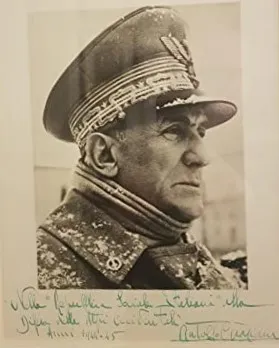
However, the real truth emerges from Broggini’s book, which recounts the version published in October 1962 in the *Roma* of Naples by Felice Bellotti, a former correspondent for the *Corriere della Sera* and Montanelli’s deputy in Helsinki. The credit for his release goes to Marshal Graziani’s wife, a friend of Montanelli’s mother, Maddalena Doddoli. On Graziani’s instructions, Bellotti, together with Valerio Benuzzi, an official at the Ministry of the Interior, met General Harster in Verona, the commander of the SD. Harster telephoned Milan and then said: “Montanelli and his wife will be released from prison tomorrow; please convey my regards to Marshal Graziani.” The problem for Bellotti arose two days later, when he was summoned by Colonel Rauff in Milan, who had not taken kindly to being bypassed. Montanelli had crossed into Switzerland the day before, and Rauff shouted at him: “Now you’re going to prison in his place!” and told him that Montanelli’s wife would be deported to Germany. Bellotti left with his legs trembling. Bellotti’s highly credible account was deliberately ignored by Montanelli, who nevertheless changed his attitude towards Graziani from that of a murderer and violent colonialist to that of a gentleman.
On his return to the Corriere della Sera, he found the editor, Mario Borsa, who despised Montanelli, having seen through his true nature, and who relegated him to a corner. Montanelli’s star began to shine once more following Borsa’s dismissal and the arrival of Guglielmo Emanuel.
The Montanelli who emerges from this book by Broggini bears more resemblance to Oscar Giannino than to Hemingway, with his outbursts when he was a guest on Bruno Vespa’s *Porta a Porta*; and whenever I hear people say that Montanelli was there and told him… Renata Broggini springs to mind.