Reginald Thomas Foster (1939-2020) was an American Catholic priest and friar of the Order of Discalced Carmelites. From 1970 until his retirement in 2009, he worked in the Latin Letters section of the Secretariat of State in the Vatican. He was an expert in Latin literature and an influential teacher of Latin, including 30 years at the Gregorian University, Teresianum and Urbanianum in Rome, and free summer courses that continued when he retired to Milwaukee.
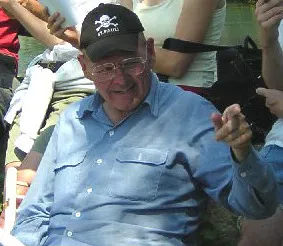
When Father Reginald Foster was chosen to serve as the Vatican’s Latinist, translating the Pope’s correspondence and decrees into the Church’s mother tongue, he could not have foreseen the imminent decline of the ancient language.
“In the old days, all priests knew Latin,” he recalls. “Some of the young priests, just a week after their ordination, were sent out to teach Latin. This was a well-known vocation for young priests.”
Foster spent many years developing and teaching his own Latin curriculum at the Pontifical Gregorian University in Rome. There, he earned a reputation as something of a cult figure, giving free lessons to thousands of students, both laypeople and priests. Most remarkably, whilst lecturing on Roman authors or leading walking tours of historical sites across Italy, the tireless priest would converse in impeccable Latin – a language rarely spoken aloud even by specialists.
Today, although Latin is still common in papal writings, it is not a regular feature of religious life or education. Foster, who served four popes, presided over a period of decline in the use of Latin that is only now showing signs of abating. As a step towards halting this decline, the Pontifical Academy of Latin, established in 2012 with the explicit aim of preserving the language’s place in the modern world, is awarding a prize of 20,000 euros for innovations in Latin education.
After a long period of decline at the end of the 20th century, enrolment in Latin has stabilised in recent decades, and a group of young educators – including Foster’s own students – are devising new methods to revive the language of the Romans.
Finding enough teachers
We cannot yet tell whether Latin is set for a comeback, not least because it is difficult to track the number of American students learning foreign languages. The National K-16 Foreign Language Enrolment Survey, published by a consortium of research and advocacy groups, has estimated that just over 10.5 million K-12 pupils (or around 20 per cent of the total K-12 population) are currently studying one of the nine most widely studied languages. Unsurprisingly, Spanish accounts for the largest share of the market, with over 7 million pupils. Latin accounts for around 2 per cent of the total, or approximately 210,000 pupils.
Whatever the actual figures, the current interest in Latin represents undeniable progress from its low point in the 1970s. A frequently cited claim suggests that, following the post-Sputnik rush to prioritize maths and science, the number of secondary school pupils studying Latin fell from 700,000 in 1962 to 150,000 in 1976. Although it has lost some of its intellectual prestige, it also seems to have avoided being consigned to the academic dustbin.
Latin is ‘holding its own’, says Abbott, who attributes the rise in enrolment to a shift towards more authentic teaching strategies, including some borrowed from modern languages. Foremost among these is the use of spoken Latin in the classroom. This approach – described variously as the ‘natural method’, the ‘direct method’ and ‘active Latin’ – marks a drastic break with the traditional grammar-translation approach, which requires the rote memorization of inflections and conjugation tables. Instead of spending long hours copying sentences from English into Latin, pupils can benefit from the same immersive environment found in Italian or Japanese classrooms.
Kathleen Durkin, a Latin teacher at a secondary school in Garden City, New York, says: “The teaching of Latin has recently gained more momentum than it has had for a very long time. There are a large number of teachers and pupils taking part in extracurricular Latin activities – trips, tours and competitions, both nationally and locally. So you have this network that seems to be constantly growing.”
In 2015, Durkin co-authored an open letter with Ronnie Ancona, head of the Classics programme at Hunter College, warning of a severe shortage of Latin teachers across the country. In both the 2012–13 and 2013–14 academic years, they wrote, Latin was cited as a specific area of shortage in their home state of New York. With a glut of PhDs in the field and a limited number of teaching posts at university level, there ought to be a steady supply of Latin specialists flowing into secondary schools.
Given the difficulties in obtaining teaching certification, however, these posts often remain unfilled.
These workforce issues are partly countered by the success of Latin and Greek enthusiasts in establishing new classical schools. At institutions such as Brooklyn Latin in New York City and St Jerome Classical School in Hyattsville, Maryland, teachers combine Latin lessons with classes on ancient mythology and Aristotelian ethics. Parents report high levels of satisfaction with the well-rounded curricula, and initial results place some classical academies among the top-performing schools in their districts.
Jason Pedicone, a former student of Reginald Foster and president of the Paideia Institute in Brooklyn, has struggled as much as anyone else with the challenge of enticing young people to take up classical studies. The organisation recreates Foster’s much-loved summer programmes, giving students the chance to study Latin texts amongst the monuments of Roman culture.
Although he encourages the practice of speaking Latin aloud in class, Pedicone is keen to distinguish Paideia’s ethos as what he calls ‘living Latin’. He describes the concept as a blend of experiential learning and service projects designed to attract young people interested in putting classical ideals into practice. “Our summer programmes, which teach Latin to secondary school and university students, have become a place where they can be inspired and enthused by the classics so that they can return and undertake service projects,” he says.
One such programme, Aequora, recruits university graduates to teach introductory Latin grammar to disadvantaged primary and secondary school pupils. The volunteers use a specially designed curriculum not only to build familiarity with Latin words and phrases, but also to strengthen their pupils’ English literacy and basic cultural knowledge. The children leave with a better command of two languages, plus a dose of ancient history and culture.
Pedicone regards Aequora’s work as valuable in its own right, but it is clear that he also sees the programme as a way of smuggling a classical education into modern classrooms. Meanwhile, the volunteers are drawn to Latin because they have used it to change the world around them.
“If you think of it like a ruthless realpolitik businessman, and you want to sell the humanities in that environment, creating opportunities to achieve social justice through the humanities is the best thing you can do.”
When asked about the value of studying Latin in the 21st century, Pedicone’s former teacher is quick to reply.
“Once you take up Latin, you’ll be captivated – if you take up genuine Latin, in a genuine way. It opens the mind. We’re still thinking in Latin terms, Latin structures, Latin reasoning. All this literature and mythology and philosophy have come down to us in Latin, and it’s still there. You can’t shake it off. The language is very much alive, whether we’re talking about Marcus Aurelius or others. Marcus Aurelius is alive because we understand him and speak to him.”