With more than 8,600 hectares of vineyards, nearly 57.5 million bottles produced, and an increasingly strategic export market, Valpolicella continues to reinforce its position as one of Italy’s leading wine regions. These findings emerge from the sixth edition of the Annual Report by the Valpolicella Wine Protection Consortium, presented in Venice.
Valpolicella remains one of the flagship wine-producing areas of both Veneto and Italy, combining a well-established production chain with a strong international presence. The denomination encompasses more than 2,200 businesses and exports its wines to 87 countries, underlining its growing importance as a key economic driver for the regional wine industry.
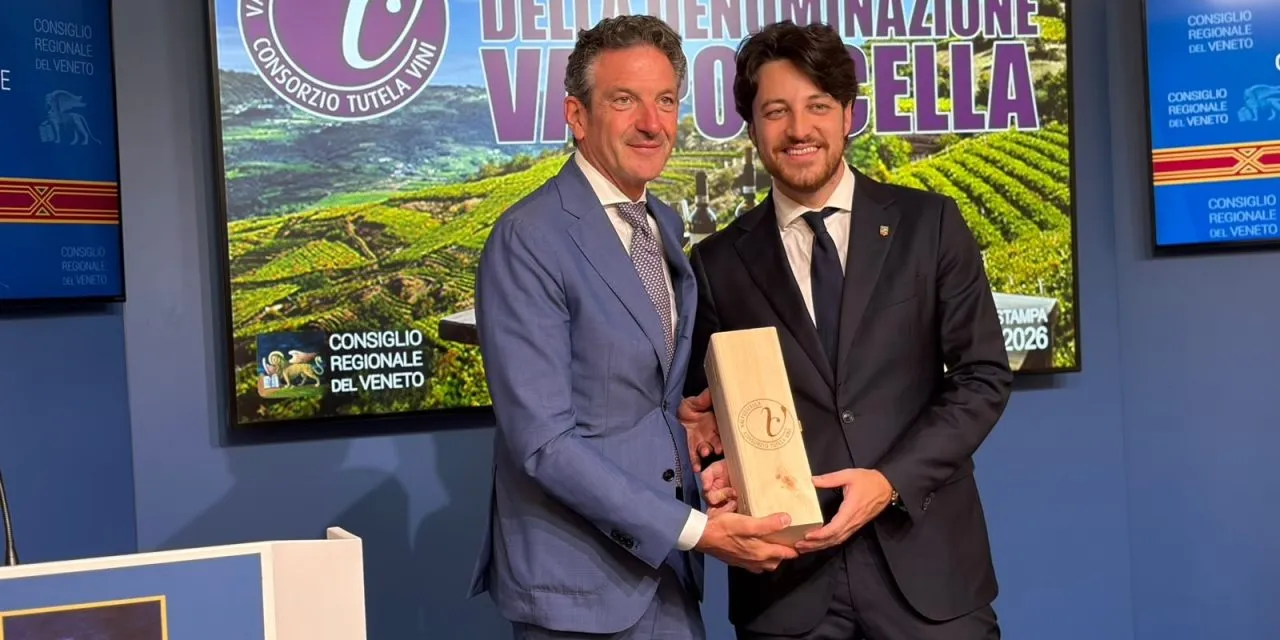
The report was unveiled at the “Oriana Fallaci” Press Room of Palazzo Ferro Fini in Venice by Veneto Regional President Alberto Stefani and Forza Italia regional group leader Alberto Bozza.

Offering a comprehensive overview of the denomination, the report examines production, market performance, sustainability, research, education, and future development. The Valpolicella appellation spans 19 municipalities and 11 valleys, covering a consolidated vineyard area of 8,614 hectares. Verona accounts for the largest share of vineyards, representing 15% of the total, followed by Negrar and San Pietro in Cariano with 13% each, and Illasi with 11%.
The region also maintains a strong varietal identity. Corvina remains the flagship grape variety, accounting for 56% of the registered vineyard area. Rondinella and Corvinone each represent 19%, while Molinara retains a 2% share.
“Exports are a fundamental growth driver for Veneto’s wine sector,” said Regional President Alberto Stefani. “More than 37% of Italy’s total wine exports originate from Veneto, confirming the strategic importance of the industry for the regional economy.”
According to Alberto Bozza, Valpolicella represents “an extraordinary territory producing wines of outstanding quality.” He highlighted the denomination’s continued international expansion, now present in nearly 90 foreign markets, while stressing the need to further support producers through targeted promotion, wine tourism, and territorial enhancement.

PRODUZIONE STABILE E NUOVE SFIDE SUI MERCATI
In 2025, grape production reached 840,510 quintals, including 327,545 quintals destined for the traditional appassimento drying process. Total bottled production stood at just under 57.5 million bottles, down 3% compared with the previous year, reflecting a period of market rebalancing following years of sustained growth.
Breaking down the figures, Amarone della Valpolicella and Recioto della Valpolicella accounted for 13.58 million bottles (-2.4%), Valpolicella Ripasso reached 27.37 million bottles (-3.7%), while Valpolicella DOC totalled 16.50 million bottles (-2.7%).
“The Valpolicella denomination continues to have a strong international focus,” said Consortium President Christian Marchesini. “In 2025 alone, we organised 27 promotional initiatives across 16 countries on five continents, further strengthening our presence in key strategic markets.”
Looking ahead, the Consortium plans to invest €6 million over the next seven years to support the international promotion of Valpolicella wines. Wine tourism is also expected to play an increasingly important role in enhancing the region’s appeal and supporting, in particular, small and medium-sized wineries.
Marchesini also highlighted the Consortium’s efforts to protect the denomination. In 2025, it secured more than €1.2 million in compensation resulting from cases of improper use of the Valpolicella name, with the funds being reinvested in promotional activities.
Technology, Sustainability and the UNESCO Bid
Climate change and technological innovation remain among the sector’s most pressing challenges. “Supporting wineries in adopting new technologies is essential to mitigate the impact of climate change,” Marchesini said.
The region’s long-term development also relies on close cooperation between local authorities and wine producers. Roberto Zorzi, Mayor of Sant’Ambrogio di Valpolicella and Provincial Councillor for Agricultural Policies, highlighted ongoing initiatives to promote sustainable practices and advance the candidacy of the Valpolicella grape-drying tradition (appassimento) for inclusion on UNESCO’s Representative List of the Intangible Cultural Heritage of Humanity.
The report confirms Valpolicella’s standing not only as one of Italy’s premier wine-producing regions, but also as a territory capable of successfully combining tradition, innovation, sustainability, and international competitiveness.