By Gianni Schicchi
Franco Zeffirelli’s monumental production of Aida returns to the Verona Arena on 30 July, reviving one of the many landmark stagings created by the celebrated Florentine director and designer over the course of his extraordinary career. His interpretation of Verdi’s masterpiece evolved over the years while never relinquishing the hallmarks of his theatrical vision: a seamless balance between breathtaking spectacle and unwavering fidelity to both the libretto and the score.
A particularly intriguing chapter came in 2001, when Zeffirelli staged a remarkably intimate Aida in the tiny Teatro Verdi in Busseto. The reduced scale allowed him, perhaps for the first time, to focus almost exclusively on the drama’s emotional core and the singers’ acting. The result was striking, although the theatre’s limited dimensions inevitably required several scenes to be cut.
Zeffirelli’s Monumental Aida
Armed with fresh ideas and renewed inspiration, Zeffirelli returned to Verona the following year to inaugurate the 80th Opera Festival with the colossal Aida that would later be transferred to La Scala in Milan. Premiered in 2002, the production represented the culmination of decades of theatrical experience and an ever-evolving visual style.
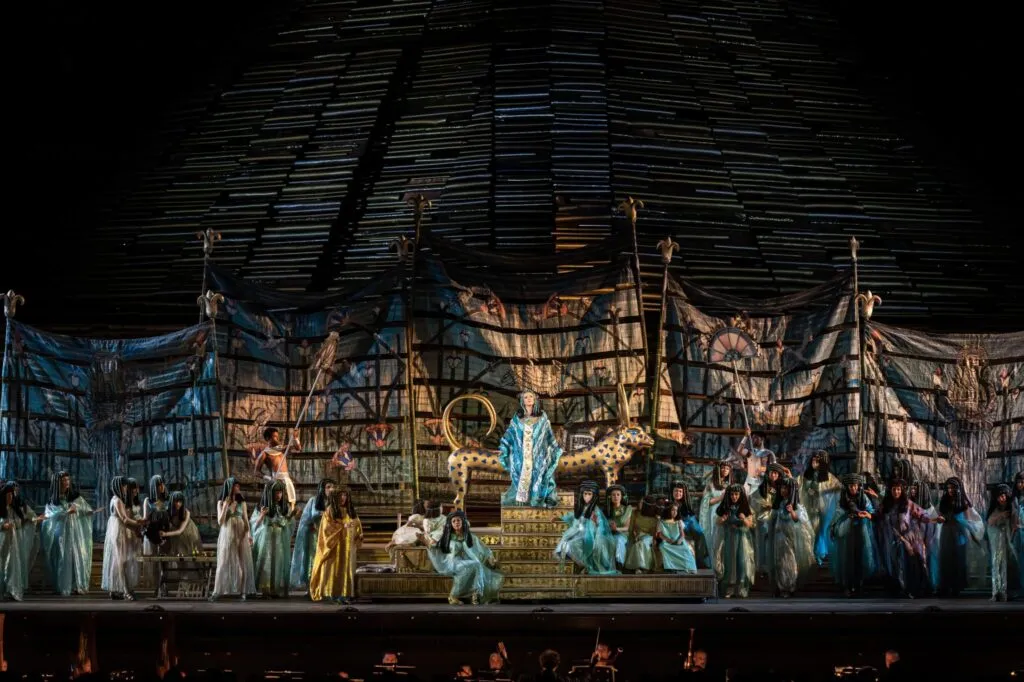
Ancient Egypt is presented not as historical reconstruction but as mythic vision, almost fairy-tale in its dazzling abundance of gold. Gold becomes both light and power within the halls of Memphis, while the imposing façades of the central pyramid transform, through swift and silent scene changes, into moonlit desert slopes, forbidding palace walls and temple precincts shrouded in drifting clouds of incense.
Within this play of light and shadow unfolds a rich palette of colour: jewel-like surfaces carved with sphinxes, complemented by the refined silks and linens of Anna Anni’s sumptuous costumes. Spaces shift with remarkable fluidity, while Zeffirelli’s masterly use of lighting continually draws the audience’s eye towards moments of intimate drama—monologues, prayers, declarations of love and whispered strategies of war.
The seven performances will be conducted by Francesco Ommassini, recently promoted to the podium after serving for many years as principal second violin of the Arena orchestra and now Artistic Secretary of Fondazione Arena. A native of Venice, Ommassini studied violin and composition before furthering his musical education at leading international institutions, including the Accademia Chigiana in Siena, the University of Music and Performing Arts in Vienna, and the Scuola di Musica di Fiesole.
Returning in the title role is Polish soprano Aleksandra Kurzak, daughter of musicians and herself an accomplished violinist before embarking on an operatic career that included membership of the Hamburg State Opera ensemble. She made her Arena debut in 2011 as Rosina in The Barber of Seville and has since appeared in Roméo et Juliette, La traviata, Rigoletto and Carmen. Later performances will feature Maria José Siri and Anna Netrebko in the role of Aida.
The role of Radamès marks the Verona debut of South Korean tenor Seokjong Baek, who switched from the baritone repertoire to tenor only a few years ago. His breakthrough came with Turandot in Prague four years ago, while his international reputation was firmly established by a sensational performance in Samson et Dalila at the Royal Opera House, Covent Garden. Baek studied at the Royal Conservatory of Music in Toronto and the Manhattan School of Music, and recently returned to Covent Garden as Radamès. He will be succeeded in subsequent performances by Roberto Alagna, Yusif Eyvazov, Paolo Lardizzone and, finally, Jonas Kaufmann.
French mezzo-soprano Clémentine Margaine will sing Amneris throughout the run. Widely regarded as one of today’s most compelling dramatic mezzos, she recently appeared as Carmen at La Scala and has already won acclaim at the Arena during the 101st and 102nd festivals, performing both Amneris and Carmen.
South Korean baritone Youngjun Park takes the role of Amonasro. After graduating from Seoul National University, he continued his musical studies at the Luigi Cherubini Conservatoire in Florence.
The role of Ramfis will be shared by basses Alexander Vinogradov, Gianluca Buratto and Simon Lim. The King will be performed by Abramo Rosalen, Simon Lim and Mariano Buccino, while the Messenger will alternate between veteran tenor Carlo Bosi and Riccardo Rados. Francesca Maionchi completes the principal cast as the High Priestess.