(Claudia Farina*) A resounding ‘Yes’ (sì) from Daniele Zamuner after a visit to the Champagne region – where the langue d’oïl was spoken in the Middle Ages – marks the origins of the winery that bears his name. ‘Oïl’ means ‘Yes’, derived from the Latin expression ‘hoc ille (fecit)’. What was Engineer Zamuner’s ‘hoc ille’ in the late 1970s? It was his unwavering determination to produce Champagne on the morainic hills of Sona, located halfway between Verona and Lake Garda. He asked questions, sought information, studied the subject, and when his French counterparts asked how many hectares of vineyard he had, he replied, ‘five’. Perhaps because they thought him deluded, or perhaps because they did not see him as a competitor, he actually received all the right information to produce his Champagne. If he is the ram, his wife Gabriella Tomat weaves the right threads around him. As a French teacher, she knows how to ask the right questions. It is well known that speaking the same language creates empathy between people of different nationalities.
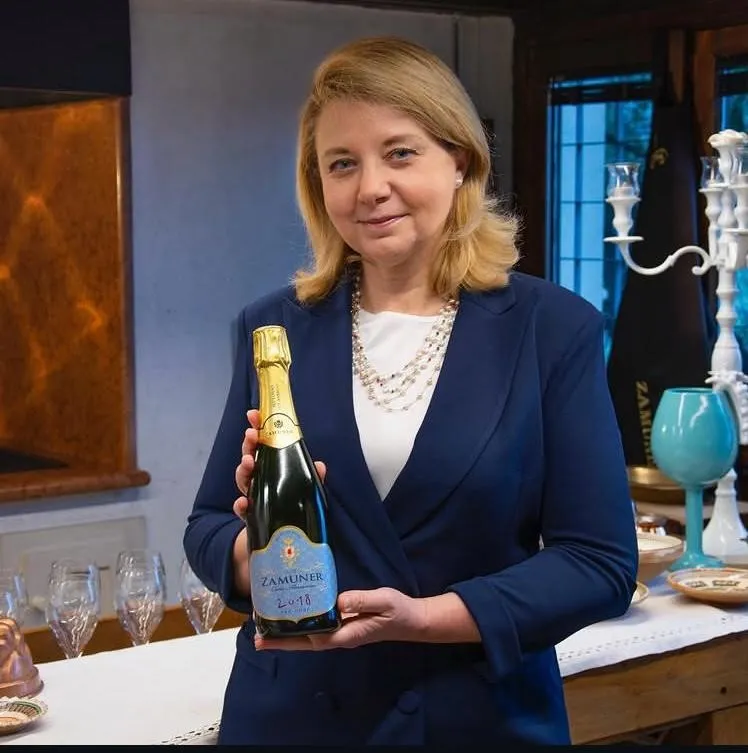
When you visit Zamuner, take your time, as his daughter Alessandra, who took over the business in 2016 after her father’s sudden passing, recounts stories, episodes, and anecdotes with a storytelling flair that enhances the wine’s value. I met her on the 6th of June at an event organised by the 4W Association, chaired by notary Maria Teresa Battista, where we sipped delightful Zamuner wines on the terrace overlooking the estate’s vineyards.
The tour begins in the cellar, with fiberglass tanks that evoke a sense of tradition, and leads to the vault, the inner sanctum of production, where the family’s treasures lie in silent repose.
Since 1981, the year of the first planting, Daniele Zamuner’s tenacity has turned a dream into reality, starting with Pinot Noir and Chardonnay cuttings, the typical grapes of Champagne.
Stepping into the Zamuner cellar is like taking a journey through time. Behind the large, reinforced door lies the vault where the historic vintages rest, jealously preserved alongside the traditional pupitres used for the remuage of the bottles. On the shelves, dozens of bottles from the 1980s still await disgorgement, a tangible testament to a philosophy that harnesses time in the service of Metodo Classico excellence, learned in the lands of Champagne and reinterpreted with character and personality in the Verona region.
The distinctive feature of this production lies in its creative freedom: as it is not bound by regulations, the winery can use the historic grape varieties of Champagne exclusively, following a rigorous and artisanal production process.
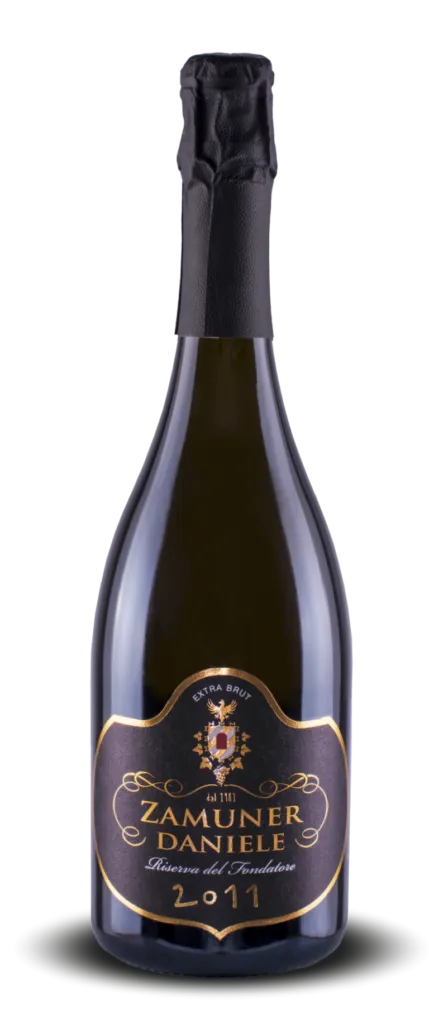
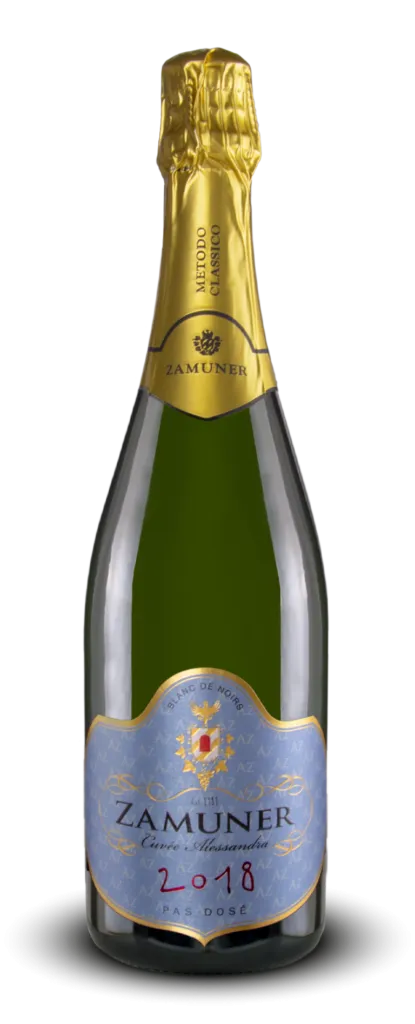
Let us briefly summarise the main steps: the dialogue with time begins with the hand harvest; fermentation takes place slowly for 10–12 days at a controlled temperature, within special containers that preserve the wine’s aromatic integrity. The magic of the Metodo Classico continues with bottling, the second fermentation, and the long ageing on the lees. This ageing process can last from 30 to 90 months for the younger Brut wines and even exceed 120 months for the vintage reserves. This is how Zamuner’s characteristics are born: a very fine perlage, an elegant and complex bouquet, and a long finish. Of the “most French of Italian sparkling wines”, we enjoyed tasting two wines particularly dear to Alessandra Zamuner: Millesimato Blanc de Noirs 2018 Cuvee Alessandra Pas dosé; Zamuner Daniele il Fondatore 2011 Extra Brut. We will be back, we will be back!
*Claudia Farina is a journalist and writer living in Verona. Specialising in travel journalism, wine culture and medieval heresies, she is editor of Gardamore magazine. She has written articles and books on Lake Garda, Africa, the Middle East, and other countries. She contributes to VeraClasse-Travel & Lifestyle Magazine and Food Travel Verde Gusto.
She is a member of various associations, including Le Donne del Vino; Wigwam (Association network for the fair, supportive and sustainable development of local communities); Fidapa (Italian Federation of Women in the Arts, Professions and Business); Onav (National Organisation of Wine Tasters).Latest published books: “Sull’onda. Intrecci d’amore e di viaggio” (Delmiglio publisher); for Cierre Grafica she has written “Catari sul Garda. Maddalena l’apostola e il vescovo donna”; “La svolta nei racconti di dieci donne”; “Boni Homini. Sulle tracce dei Catari e di Maria Maddalena”; “Puri Cristiani. I Catari dal Piemonte alla Sicilia”.