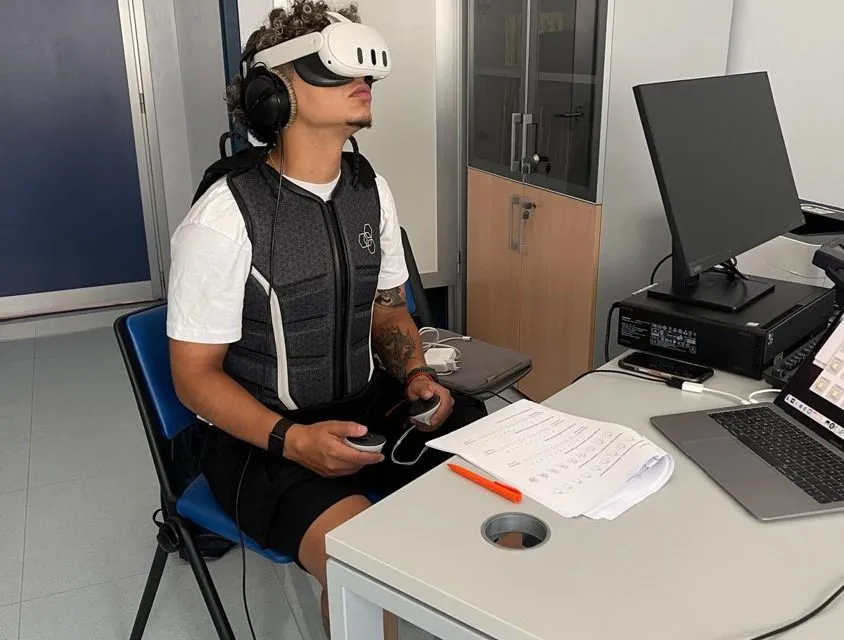
A vibrating acoustic jacket and an immersive headset are being used to help deaf people with cochlear implants do more than simply understand speech — they could allow them to experience music on an emotional level.
The pioneering research comes from the Regional Specialist Centre for Bionic Hearing Surgery and Rehabilitation at Verona’s University Hospital (AOUI), led by Dr Marco Carner.
Following trials in 2025, when the Verona centre became the first in the world to assess the effectiveness of a vibrotactile jacket in musical listening, researchers have now added a specially developed headset designed to provide visual stimulation. Early results from combining the two devices have been encouraging, improving auditory performance and enabling patients to engage more fully with both speech and music.
The virtual-reality headset, developed by Professor Turchet of the Department of Information Engineering and Computer Science at the University of Trento, creates immersive visual scenes corresponding to the rhythm and musical genre. More dynamic imagery accompanies energetic pieces, while softer compositions are paired with delicate, spring-like landscapes.
The jacket, meanwhile, conveys elements of sound through vibrations that can be felt across the body.
Tests carried out last year on more than 20 cochlear-implant patients, aged between 19 and 81, had already shown a significant improvement in the ability to perceive and distinguish sounds and speech, including in noisy environments. The addition of visual stimulation now appears to extend the experience further, bringing the emotional dimension of music within reach.
THE BIONIC EAR THAT CAN HEAR MUSIC
“The study has now shown that musical listening can be extended into the emotional sphere — an area that, until now, had been beyond the reach of patients with a bionic ear,” said Dr Marco Carner.
The specialist said the “synesthetic” approach, combining auditory, tactile and visual stimuli, could improve speech comprehension while enhancing musical perception by activating additional neural pathways.
“The acoustic-vibratory jacket, activated simultaneously with the visor, produced remarkable auditory results that had never been achieved before,” Dr Carner said, pointing to new possibilities for rehabilitation.
The research also has wider social implications. Hearing loss can contribute to social isolation and difficulties in relationships and, particularly among older people, inadequate treatment may be associated with cognitive decline. In children, undiagnosed hearing loss can interfere with brain development and social interaction.
The AOUI Verona Regional Centre was established in 2000 and operates within the Ear, Nose and Throat department headed by Professor Luca Sacchetto. It now treats around 1,000 patients, approximately 75 per cent of whom come from outside the Veneto region.
Alongside cochlear implants, the centre provides a range of bionic hearing prostheses and specialist audiology, speech therapy, rehabilitation and telemedicine services.
The partnership between AOUI Verona and the University of Trento will continue, with researchers seeking to refine the technology and develop new forms of rehabilitation for people with hearing impairments.